Dispatch to invoice, without the double entry.

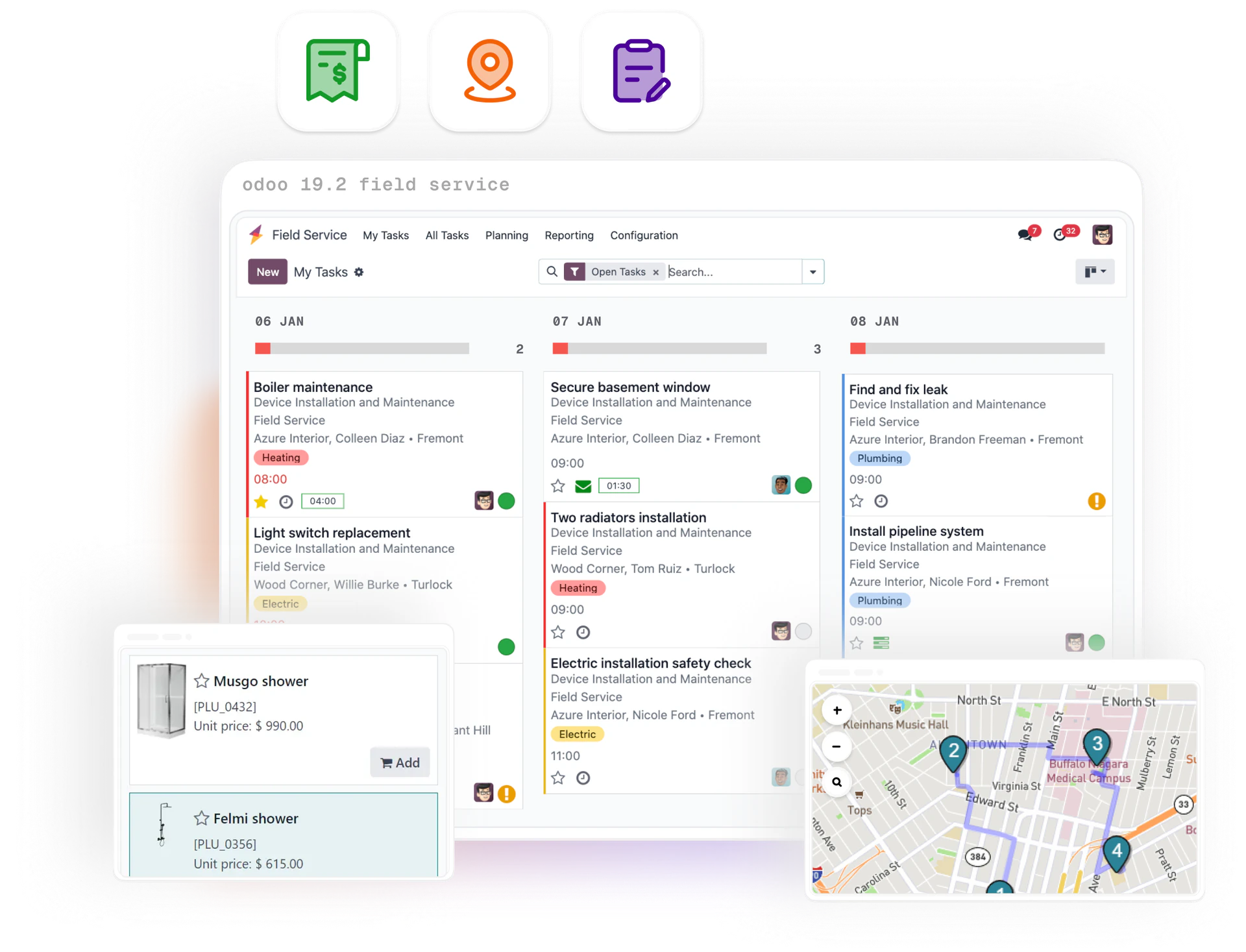
For HVAC, plumbing, electrical, facility, and home services — Odoo Field Service combines dispatch, mobile work orders, service contracts, and invoicing in one system.
Why field service operations run on systems that don't talk.

Most mid-market field operators run ServiceTitan or Jobber for dispatch + QuickBooks or Sage for accounting + maybe a CRM, fleet tool, and contract-revenue spreadsheet. The tools work individually; the integration never quite does — and truck inventory, contract forecasting, and tech utilization all suffer.

Odoo Field Service + Inventory + Accounting + HR puts it in one system. A tech's mobile app consumes van parts, captures time, gets a signature, and generates an invoice before leaving — so by end of day dispatch has profitability visibility, accounting has invoices in AR, and fleet has replenishment triggers.

— Capabilities

Field operations end-to-end.

Dispatch

Route optimization, skills matching, and SLA-driven scheduling.

Mobile app

Techs take jobs, capture photos, get signatures, and clock time from their phone.

Service contracts

Recurring contracts, preventive maintenance schedules, SLAs.

Truck inventory

Van stock tracking, replenishment, and consumption on jobs.

Billing

On-site invoicing, recurring billing, and contract renewal workflows.

Analytics

First-time fix rate, tech utilization, contract profitability.

— Questions

Field services — FAQ.

Does the mobile app work offline?
Yes. Techs can view jobs, capture work, and get signatures offline. Everything syncs when reconnected. Critical for jobs in basements, crawlspaces, or remote sites where connectivity is unreliable.
Can we track van inventory?
Yes. Each vehicle is an inventory location. Parts consumed on jobs decrement the van automatically, trigger replenishment from the main warehouse, and update accounting in real time. Cycle counts can happen at route-end.
How does dispatch optimization work?
Native scheduling considers tech skills, location, availability, job priority, and SLA. For sophisticated route optimization (large fleets, dense urban routing) we integrate Onfleet, OptimoRoute, or similar tools while keeping Odoo as the system of record.
What about service contracts and recurring billing?
Service contracts define preventive maintenance schedules, included visits, parts inclusion rules, and renewal terms. System generates recurring billing automatically, triggers preventive maintenance jobs, and tracks contract profitability (actual cost vs. contracted revenue).
Does it compare to ServiceTitan or Jobber?
ServiceTitan has deeper trades-specific features (pricebook, accessory recommendations, some sales coaching) targeted at high-end residential HVAC. Jobber is simpler and cheaper. Odoo sits between them on features, but wins on integration — it's one system with accounting, inventory, HR, and CRM natively connected.
Can we handle commercial and residential both?
Yes. Multi-segment operations with different pricing, billing rhythms (residential mostly one-time; commercial often contracted), and customer portals. We've deployed for operators running both and for operators who specialize.

Vans, jobs, invoicing — one system?

30-min field-services review. Dispatch, mobile work orders, service contracts, and invoicing in one Odoo stack — techs in the field, office in sync.

Book a field-services review