Odoo ERP, implemented end-to-end.
Open-source ERP, deployed end-to-end by a certified partner, from mid-market rollouts to a 500,000-employee government engagement. Go-lives in 12-20 weeks.
- Certified Odoo Partner
- ISO 12207 & 27001 certified delivery
- Since 2005 20 years enterprise delivery
- 50+ Odoo implementations
- 500K-employee Odoo HR & payroll deployment
Why Odoo, and why end-to-end partnership matters more than the software.
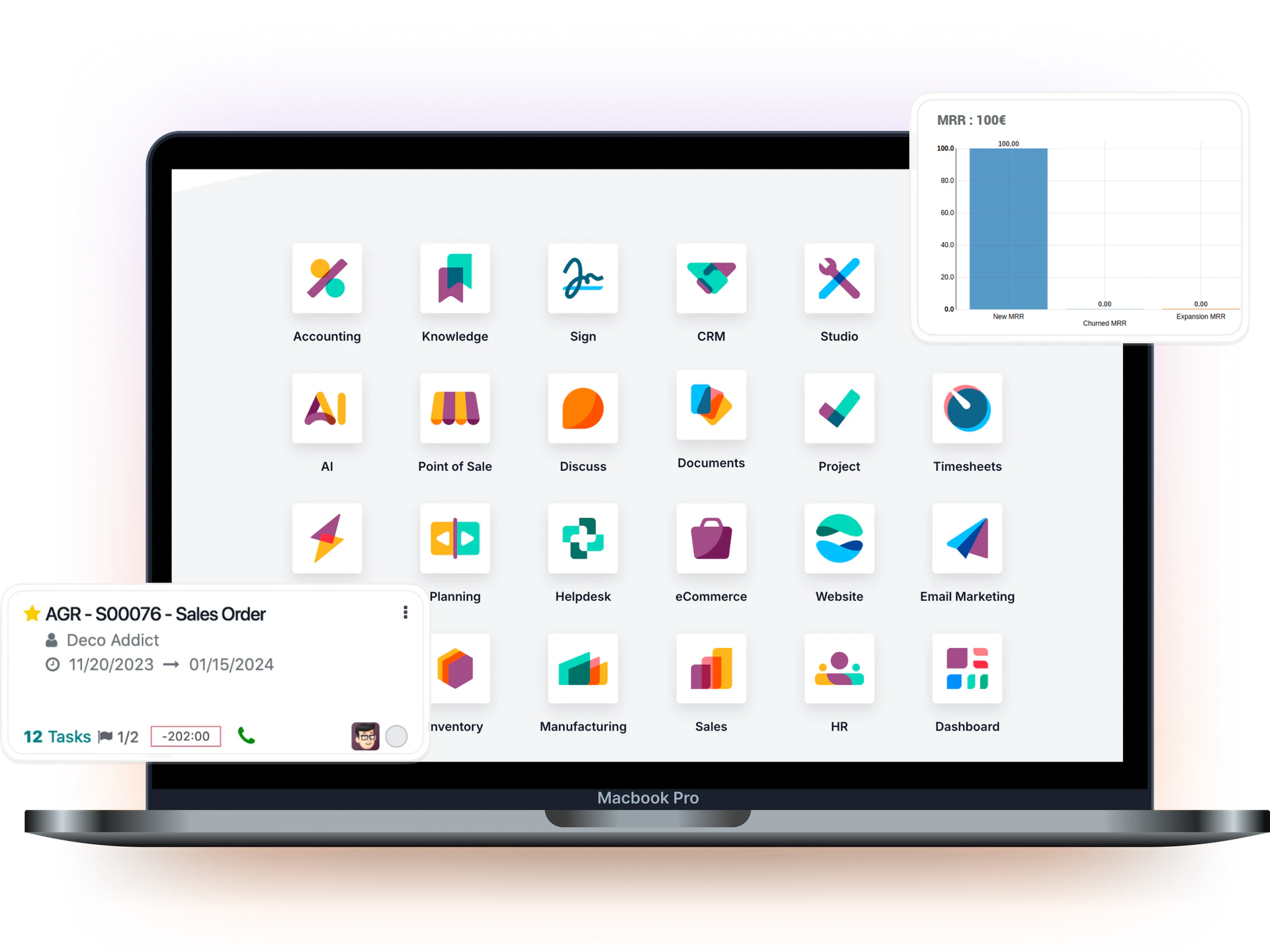
Odoo is the most-deployed open-source ERP, 12M+ users, 40+ modules, a fraction of SAP, NetSuite, or Dynamics 365 cost.
Its flexibility is also its trap. We've rescued dozens of failed Odoo projects, configured without discovery, customized without discipline, migrated without validation. The partner matters more than the software.
One platform. Every department. Actually integrated.
Accounting
Multi-currency, multi-company, bank reconciliation.
CRM & Sales
Pipeline, quotations, subscriptions, retention.
Inventory
Real-time stock, barcode workflows, replenishment.
Manufacturing
MRP, work orders, quality, BOM management.
Human resources
Records, payroll, leave, recruitment, appraisals.
Purchase
RFQs, approvals, vendor scorecards, spend analytics.
Point of sale
Retail and restaurant, online or offline.
Project & timesheets
Plan, track, and invoice projects in one tool.
Seven phases, rehearsed over 50+ implementations.
Same backbone every engagement. Sequence and gate criteria stay consistent, they catch the problems that kill ERP projects.
- 01
Discovery (2-4 weeks)
Workshops with process owners, gap analysis, solution design. Output: solution architecture and firm budget.
- 02
Configuration (3-8 weeks)
Module setup, COA, tax rules, approvals, user roles, configured to your operations. Weekly demos to process owners.
- 03
Customization (parallel, 4-12 weeks)
Upgrade-safe modules using Odoo inheritance patterns. Code-reviewed, CI-tested, documented. No modifications to Odoo core.
- 04
Data migration (parallel, 4-8 weeks)
Master data, then open transactions, then historical balances, reconciled at every stage. Migrated three times before cutover.
- 05
Training (2-4 weeks pre go-live)
Role-based cohorts with hands-on exercises in a production-mirror instance. Day-in-the-life simulations surface gaps.
- 06
Go-live cutover (1 weekend)
Rehearsed twice. Runbook with go/no-go gates. Rollback path tested. If it breaks, we revert and try again next weekend.
- 07
Hypercare (4-8 weeks)
Embedded support with response SLAs, daily stand-ups, active bug fixing. Team is self-sufficient by handover.
Go-lives 40% faster, with fewer surprises.
Process mapping, data migration, UAT, and change management run in parallel, not in sequence. Every phase has exit criteria we don't bypass under commercial pressure.
- Structured discovery in 2-4 weeks
- Parallel data migration and configuration
- Rehearsed cutover with tested rollback
- Training built into the delivery plan
Standard when it fits, custom when it doesn't.
Configuration covers 80% of use cases. The rest goes into upgrade-safe custom modules using Odoo inheritance patterns, separate, versioned, never a modification to core.
- Python developers on staff
- Custom modules tested against every Odoo release
- Zero core modifications
- Full source, docs, and repo access delivered
What our clients actually see.
Representative results from recent mid-market implementations, first 12 months post-go-live.
Regional manufacturer, 12 plants across 3 continents.
Multi-warehouse distributor, up from 72% in 6 months.
4-entity professional services firm, down from 14.
How Odoo compares.
Honest head-to-head. We've migrated clients onto Odoo, and a few off it when the fit wasn't right.
| Dimension | Odoo Enterprise | SAP Business One | NetSuite | Dynamics 365 BC |
|---|---|---|---|---|
| License cost (mid-market) | $40-120/user/mo | $90-180/user/mo | $100-200/user/mo | $70-120/user/mo |
| Deployment time (typical) | 12-20 weeks | 16-28 weeks | 20-36 weeks | 16-28 weeks |
| Module breadth | 40+ native | Core + marketplace | Core + marketplace | Core + marketplace |
| Customization | Open source, flexible | SDK-based, moderate | SuiteScript, moderate | AL/X++, moderate |
| Vendor lock-in | Low (open core) | High | High | High |
| Best for | Mid-market, multi-module | SAP-ecosystem subsidiaries | Global SaaS, subscription | Microsoft-ecosystem shops |
When Odoo ERP is the right call.
Strong fit
- Mid-market organizations (50-5,000 employees) looking to consolidate 5+ point tools
- Multi-entity groups needing unified financials and consolidated reporting
- Companies outgrowing QuickBooks, Xero, or spreadsheets
- Manufacturers, distributors, retailers with operational complexity
- Teams that value open architecture and avoid vendor lock-in
- Organizations willing to invest in proper implementation rather than DIY
Poor fit
- Very small businesses (< 15 employees) with simple single-product ops
- Enterprises already deep in SAP S/4HANA or Oracle ecosystems
- Highly regulated industries requiring specific pre-certified platforms
- Companies looking for the cheapest possible implementation, you'll regret it
- Organizations unwilling to map and redesign processes as part of the work
How we deliver Odoo, structured, rehearsed, rollback-tested.
Every Odoo engagement we take on runs through the same seven-phase delivery methodology, structured discovery, parallel configuration and data migration, rehearsed cutovers with tested rollback paths, role-based training, and 4-8 week hypercare. Refined across 50+ implementations including one of our largest engagements to date.
Odoo ERP, the questions we actually get asked.
How does Odoo compare to SAP Business One specifically?
What's the typical timeline from kickoff to go-live?
Which Odoo edition do you recommend?
What happens if your custom modules break after an Odoo upgrade?
Can you migrate us from our current ERP?
How do you handle multi-entity and multi-currency consolidation?
Is our data secure in Odoo?
What's included in ongoing support after go-live?
What if the project doesn't go as planned?
Ready to consolidate on Odoo ERP?
30-min scoping call. Senior consultant maps the modules and gives you a phased plan with fixed-fee scoping in 5 business days.
Book an ERP scoping call