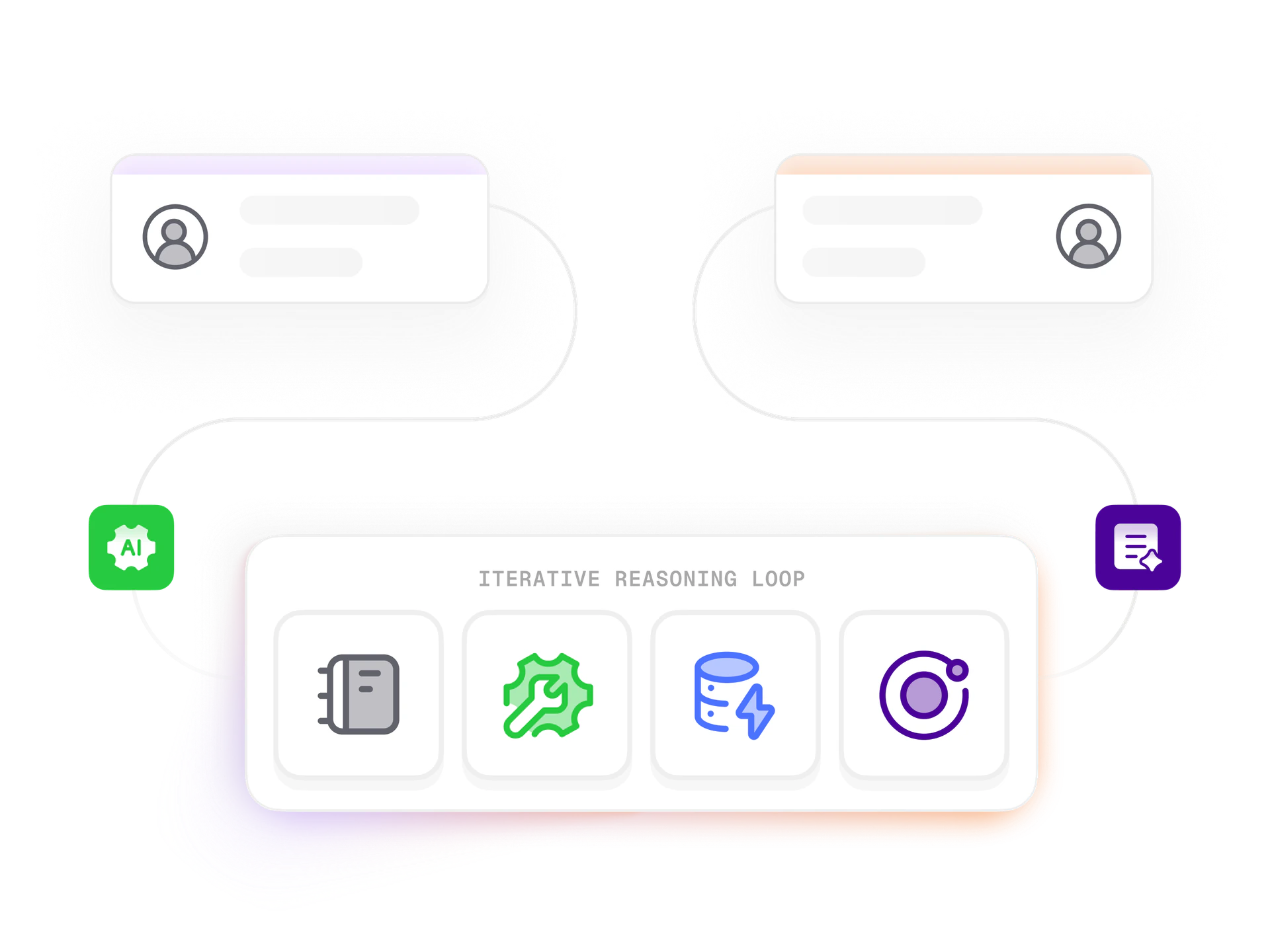
Agents that don't just chat — they work.

Agents grounded in your data, governed by your rules, observable end-to-end. They close tickets, reconcile invoices, and handle procurement — with full audit trails.

What makes AI agents work in production.

Most enterprise AI pilots don't reach production. Demos look incredible, then reality hallucinates a refund policy that doesn't exist or fails compliance review. Production AI is 20% prompt engineering, 80% surrounding infrastructure.

We ship agents that work — hybrid retrieval, eval harnesses, CI guardrails with adversarial tests, full decision logs, human-in-the-loop on high-stakes. Where it pays off — support (40-60% tier-1), invoices (85%+ touchless), procurement, document review, HR helpdesk.

— Where agents work

Use cases we've deployed to production.

Customer support

Tier-1 agents resolving 40-60% of tickets.

Invoice processing

OCR + LLM 3-way match. 85% touchless.

Procurement

Vendor negotiation within policy, outliers flagged.

Document review

Contract, lease, compliance — source-cited.

HR helpdesk

Policy-aware leave, benefits, expense questions.

Observability

Decisions logged, sources cited, escalations tested.

— How production AI gets built

Six layers we get right so production agents don't fail.

Each layer is where a different class of failure hides. Skip one and find out at scale.

  1. 01

    Grounded retrieval

    Hybrid vector + keyword search, careful chunking, cross-encoder reranking, eval harness for precision and recall.

  2. 02

    Structured prompts with guardrails

    Prompts are versioned artifacts. Guardrails enforced as CI policy tests — hundreds of adversarial cases per deploy.

  3. 03

    Observability and decision logging

    Every decision logs inputs, tools, sources, model and prompt versions, rationale. Replayable by compliance and ops.

  4. 04

    Human-in-the-loop for high-stakes

    Agents compose, humans commit. Customer promises, financial commitments, legal outputs route through review.

  5. 05

    Model-agnostic infrastructure

    Gateway-routed (Vercel AI Gateway, OpenRouter, self-hosted) — model swaps are config, not code.

  6. 06

    Evaluation against blind control

    Shadow control for 4-8 weeks measuring resolution, accuracy, CSAT, cost. Scale only if numbers are real.

— Real numbers

Production agent results.

58%
Tier-1 resolved

B2B SaaS support agent — 4.6/5 CSAT against 12-week blind control.

87%
Touchless invoices

Mid-market distributor — 13% edge cases route to human.

-42%
Document review time

Services-firm legal team — lawyer verifies flags and references.

— Honest fit

When an AI agent is actually the right tool.

Strong fit

  • High-volume repetitive knowledge work (support, invoice processing, HR triage)
  • Tasks with clear ground truth that can be evaluated
  • Domains with defined policies the agent can be constrained to
  • Workflows where a human can review and escalate ambiguous cases
  • Organizations willing to invest in proper evaluation rather than shipping PoCs

Poor fit

  • Tasks requiring judgment, empathy, or creativity at the core
  • High-stakes one-shot decisions without human review
  • Domains without reliable ground truth for evaluation
  • Organizations unwilling to invest in observability and eval harnesses
  • Use cases where a simpler rule-based automation would work
— Questions

AI automation — FAQ.

Which LLM do you use?
Model-agnostic. Claude (Opus/Sonnet) for complex reasoning and longer contexts; GPT-4/GPT-5 for some specialized workloads; open models (Llama, Mistral) when data residency, cost, or customization demands it. Routed through gateway infrastructure for observability and failover.
What about data security?
No training on your data — ever. We default to zero-data-retention endpoints with every provider we use. For sensitive domains we deploy in your VPC or use self-hosted open models. For regulated industries (healthcare, finance, defense) we configure air-gapped deployments with specific model instances.
What's the ROI?
Depends heavily on use case. Tier-1 support agents typically return 3-5x in Year 1 on labor savings alone. Invoice processing 4-8x. Document review 2-4x. We model ROI during discovery with honest assumptions — you can say no if the math doesn't work. We won't pitch AI where it's not justified.
How do you prevent hallucinations?
Grounded retrieval (agents answer from your documents, not training data). Structured output validation (agent output parsed and typed). Confidence thresholds (below threshold, escalate). Source citations (every claim ties to a document chunk the user can verify). Adversarial testing in CI. No single technique prevents hallucinations — the combination reduces them to rare, containable events.
How do we measure whether the agent is working?
Evaluation harness run continuously: golden set of inputs with expected outputs. Shadow traffic against blind control group. Production metrics: resolution rate, handoff rate, customer satisfaction, cost per interaction. We define success criteria upfront and measure continuously, not just at launch.
What happens when the agent is wrong?
Every agent has escalation paths: to a human reviewer, to a specialist team, or back to the user with an apology and human follow-up. Wrong decisions are logged, root-caused, and the agent (retrieval, prompts, or guardrails) updated. This is why observability is non-negotiable.

Want agents in production — not demos?

30-min feasibility call with a senior AI engineer. Use case assessed, build mapped, fixed-fee pilot scope — observability and audit trails included.

Book an AI feasibility call