Software that fits your business, not someone else's.

A senior product team embedded with yours — designers, PMs, engineers, all senior. Prototype in weeks, ship in months, stick around to maintain. No pass-the-parcel to juniors.
Why most custom software projects drift into disappointment.

Custom software fails predictably — senior architect wins the deal, hands execution to juniors, MVP ships acceptably then breaks in year one as scope outgrows the codebase. Clients pay twice.

Every squad has a senior lead on every role. Boring defaults — TypeScript, Postgres, standard observability — because boring means well-understood failure modes at 2am. Several of our builds are still in production a decade in.

— What we build

Products, platforms, tools.

SaaS products

Multi-tenant platforms — auth, billing, RBAC built in.

Internal tools

Line-of-business apps replacing spreadsheets.

Data platforms

Pipelines, warehouses, analytics tools.

Customer portals

Self-service portals reducing support load.

Chat & collaboration

Real-time messaging, doc collab, activity feeds.

Compliance apps

Audit-ready workflows for regulated industries.

How we work

Senior squads, modern defaults.

Senior lead on every role — engineer, designer, PM. Stack is boring on purpose: TypeScript/PHP, Postgres/MySQL, Kubernetes or serverless. Deploy, monitor, rollback are first-class from day one.
  • Senior-only teams — no pass-through to juniors
  • Stacks: TypeScript, Python, PHP, Postgres, MySQL, Kubernetes
  • CI/CD, observability, IaC from day one
  • ISO 12207 + ISO 27001 certified delivery
  • SSO, RBAC, audit logs, encryption by default
  • Design system built to extend, not locked to scope
Start a project
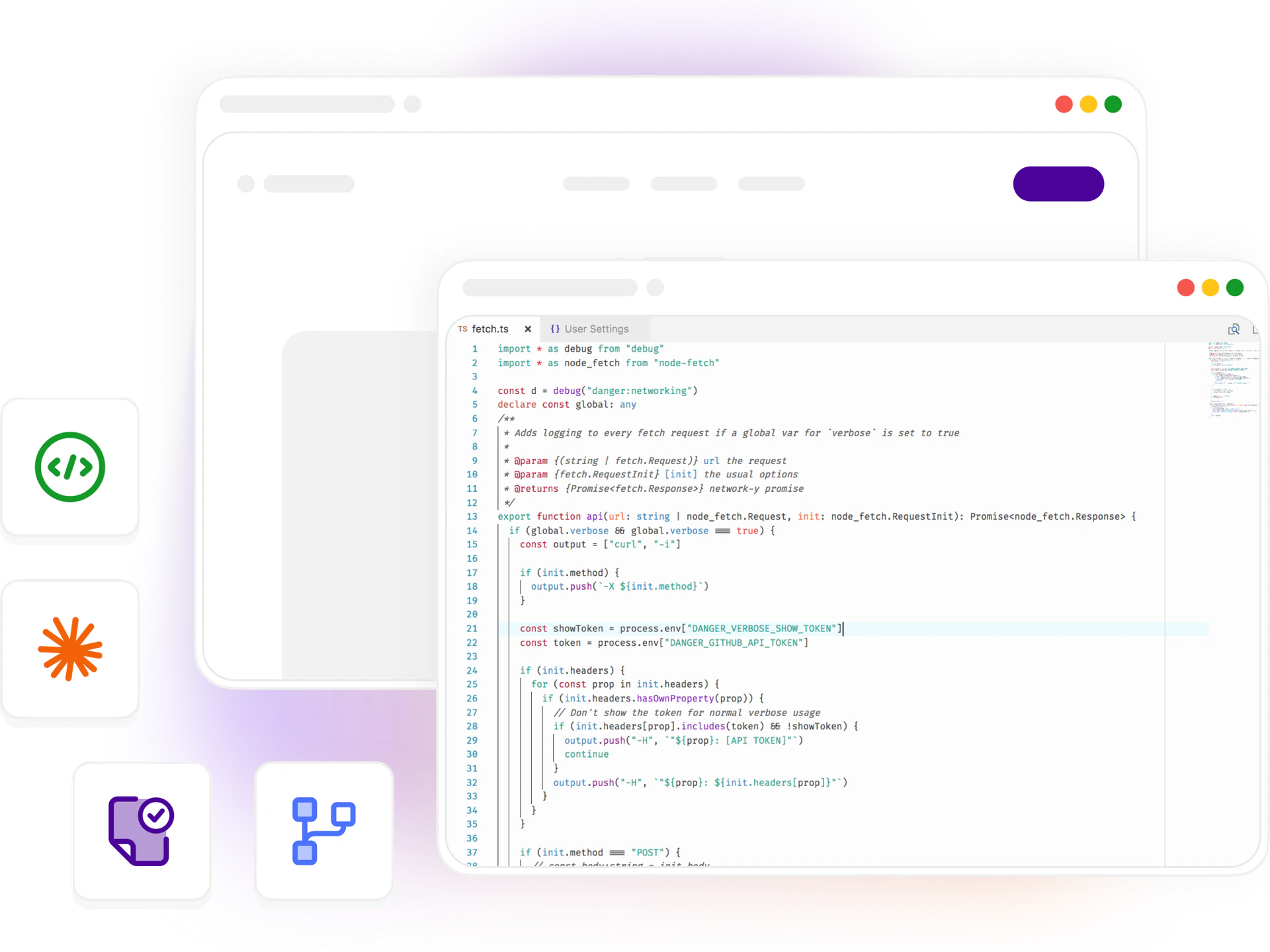
Editor windows and CI/CD icons — senior squads shipping TypeScript on modern defaults
— Tech stack

Our default stack — and what we reach for beyond it.

Boring, battle-tested defaults — every item below has shipped more than once. AI-assisted tools used under the same code review and security discipline.

Languages
TypeScript TypeScript
Python Python
PHP PHP
+ also
Go Go
Rust Rust
Web frontend
Next.js Next.js
Astro Astro
React React
Vite Vite
+ also
Svelte / SvelteKit Svelte / SvelteKit
Vue Vue
Backend / APIs
Node.js Node.js
Hono Hono
NestJS NestJS
FastAPI FastAPI
Laravel Laravel
Livewire Livewire
Filament Filament
+ also
Django Django
Go services Go services
Mobile
React Native React Native
+ also
Swift Swift
Kotlin Kotlin
Data
PostgreSQL PostgreSQL
MySQL MySQL
Redis Redis
+ also
Clickhouse Clickhouse
pgvector pgvector
DynamoDB DynamoDB
AI & ML
OpenAI OpenAI
Anthropic Anthropic
Vercel AI SDK Vercel AI SDK
LangChain LangChain
pgvector pgvector
+ also
LlamaIndex LlamaIndex
AI-assisted delivery
Claude Code Claude Code
Cursor Cursor
GitHub Copilot GitHub Copilot
Cloud & infrastructure
AWS AWS
Vercel Vercel
Kubernetes Kubernetes
Docker Docker
Terraform Terraform

+ also
Azure Azure
Google Cloud Google Cloud
Observability
OpenTelemetry OpenTelemetry
Sentry Sentry
Grafana Grafana
Prometheus Prometheus
CI & delivery
GitHub Actions GitHub Actions
Vercel deploys Vercel deploys
+ also
GitLab CI GitLab CI
CircleCI CircleCI
Auth & secrets
AWS Secrets Manager AWS Secrets Manager
Testing
Vitest Vitest
Playwright Playwright
Pytest Pytest

Delivered through ISO 12207 software lifecycle and ISO 27001 information security controls — held by NETLINKS Ltd.

— Honest fit

When custom is the right answer.

Build custom when

  • No off-the-shelf tool covers the core workflow adequately
  • The software is differentiating — it's part of your moat
  • Regulatory or industry constraints require specific data handling
  • You have budget for long-term maintenance (build is ~20% of TCO)
  • The team to maintain it post-build exists or can be hired

Don't build custom when

  • A SaaS tool can do 85% of what you need (configure, don't code)
  • The requirement is likely to change quarterly (configure or buy)
  • Budget doesn't cover 3-5 years of maintenance cost
  • Nobody on your team can own the system after launch
  • The differentiation argument is vague rather than specific
— Questions

Custom software — FAQ.

Do you do fixed-bid or time-and-materials?
Both, depending on scope clarity. MVPs are often fixed-bid after a discovery sprint. Platform work is usually T&M with sprint-level commitments. We never hide budget risk behind change-order chains.
What does a squad look like?
Typical squad: lead engineer (senior) + 2-3 engineers (mix of senior and mid) + designer (senior) + PM (senior). For larger builds, multiple squads coordinate under a single tech lead. For narrow technical tasks (a specific module or integration), smaller teams work.
What tech stack do you use?
Default stack: TypeScript, Python, and PHP as primary languages; Next.js, Astro, and React for web; Node.js (Hono, NestJS), FastAPI, and Laravel (with Livewire and Filament for admin) for backend; PostgreSQL and MySQL for transactional data; Redis for caching and queues; S3-compatible object storage; Kubernetes or serverless (Vercel, AWS Lambda) for compute; OpenTelemetry, Sentry, Grafana, and Prometheus for observability — all open source. For rapid MVPs and time-boxed engagements we use AI-assisted development (Claude Code, Cursor, GitHub Copilot) to compress cycle time. For specific domains we reach for Go on high-throughput services and Rust on performance-critical components. Full stack table on this page.
What about long-term support?
We offer support retainers covering bug fixes, enhancements, platform upgrades, and security patches. Clients commonly stay with us for 3-5 years post-launch. If you want to internalize the team, we do structured handover with 3-6 months of knowledge transfer.
Do you use offshore or nearshore?
Senior leads are staffed from the US. Engineering capacity comes from our own Gandhinagar, India delivery center and our Dubai, UAE office — all direct hires on our payroll, not subcontracted. We occasionally bring in specialist contractors (iOS Swift, niche ML, specific industry expertise) under direct supervision — never pass-the-parcel.
How do you approach testing?
Unit tests for business logic (not test-for-test's-sake). Integration tests for API contracts. End-to-end tests for critical user flows only (they're expensive to maintain). CI runs all tests on every commit. Type safety (TypeScript strict mode) catches a category of bugs before tests run.
What about security and standards?
Secure-by-default architecture: SSO via SAML/OIDC, role-based access control, encryption at rest and in transit, audit logging, secrets in a vault (not env vars). Dependency scanning in CI. Penetration testing before production for security-sensitive apps. Information security governed by our group's ISO 27001 certification; software lifecycle governed by ISO 12207. HIPAA and PCI extensions configured when required.
What about AI/ML features?
We integrate AI features (LLM-powered search, embeddings, agent workflows) where they provide real value. Rigorously, not trendily — every AI feature has clear success criteria, failure modes, observability, and cost tracking. See our agentic AI practice for detail.

Custom build coming up?

30-min architecture review with a senior architect — not an SDR. We map the build, surface risk, and propose a phased plan.

Book a 30-min architecture review