Custom, but upgrade-safe.

Custom modules that respect Odoo conventions, survive upgrades, and stay maintainable for years.
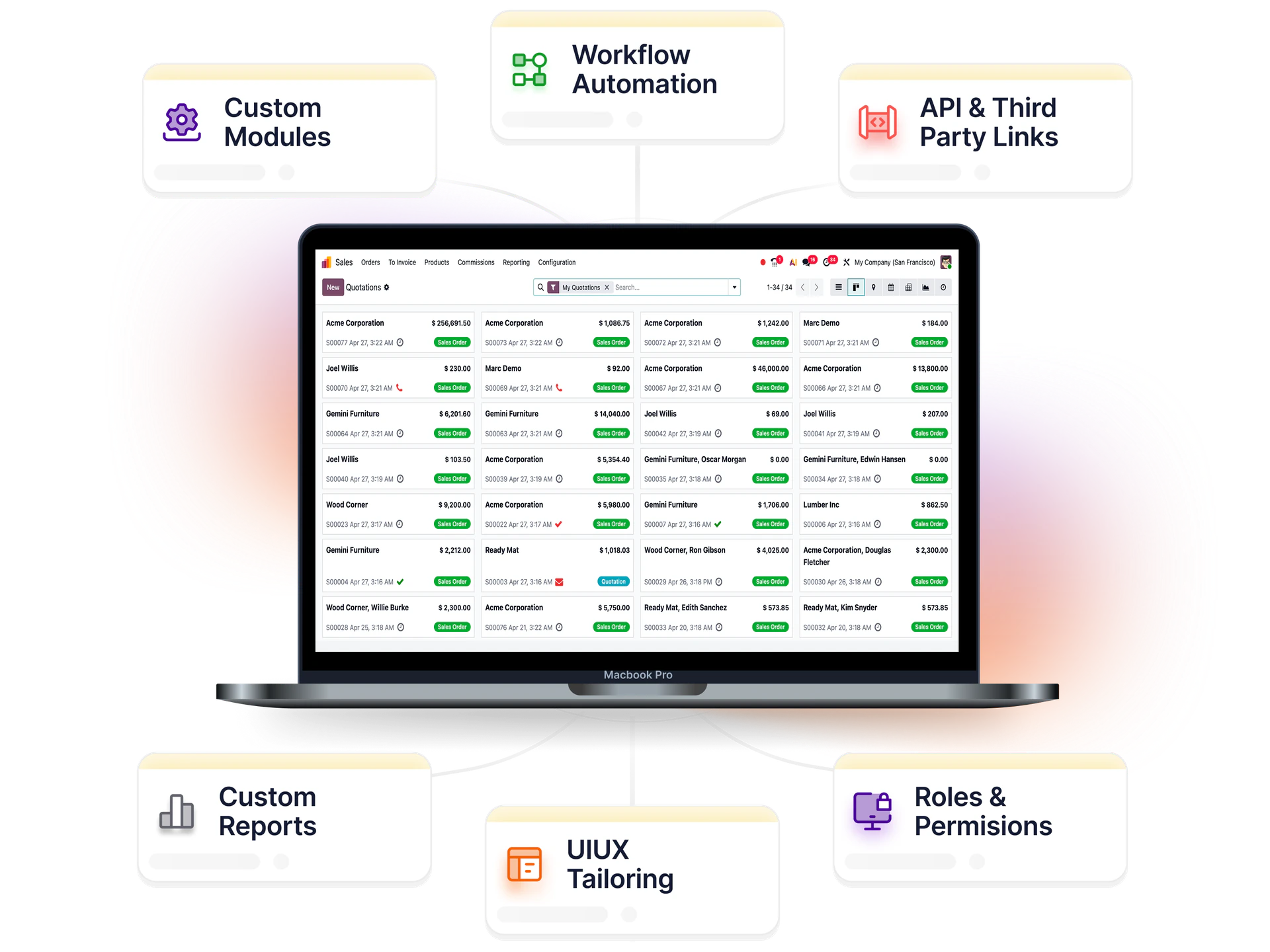
Why most Odoo customization becomes a tech-debt bomb.

Odoo's flexibility is its most dangerous feature — the same openness that lets a skilled partner fit the system lets an unskilled one monkey-patch core. By year three, unmaintainable.

Our approach — always inherit, never modify. Versioned modules with a clear purpose, strict adherence to Odoo conventions, tests in CI against new releases, mandatory senior code review. Customizations that survive upgrades and stay readable three years in.

— What we build

Custom modules, done right.

Custom views

Forms, lists, kanbans, dashboards for your workflows.

Automations

Business rules, approvals, scheduled jobs.

Reports

PDFs, analytics, regulatory filings.

Custom fields & objects

Data models shaped to your business.

Custom web portals

Branded portals for customers, vendors, partners.

Upgrade testing

Custom code tested against Odoo's release train.

— How we build

Engineering practices that keep custom code maintainable.

  1. 01

    Always inherit, never modify

    Zero modifications to Odoo core. Every customization is a separate module extending via Python inheritance and view overlays.

  2. 02

    One module, one purpose

    Accounting logic in an accounting module, sales in sales. Each ships with README and CHANGELOG — single-responsibility applies.

  3. 03

    Tests in CI

    Unit and integration tests run on every commit, plus against beta releases of the next Odoo version.

  4. 04

    Code review always

    No merges without senior review — correctness, conventions, upgrade safety, performance, docs.

  5. 05

    Version control with release tags

    Modules in your repo (or one we manage with full access). Semantic versioning, tagged releases, CI/CD deploy.

  6. 06

    Upgrade path tested

    Before any version upgrade, custom modules run against the new version in staging. Breaking changes fixed before production.

— Honest fit

When custom development is the right answer.

Build custom when

  • Standard Odoo misses a requirement central to your workflow
  • Integration requirements exceed what a no-code tool supports
  • Compliance or audit needs require specific data structure or workflow
  • You have sustained customization appetite and a budget to maintain it
  • Industry-specific modules don't exist or are poorly maintained

Don't build custom when

  • Standard Odoo can be configured to meet the need (start there)
  • Odoo Studio (drag-and-drop) can solve it for small requirements
  • A one-off data change would suffice instead of a permanent customization
  • The requirement is likely to change in 3-6 months (configure don't code)
  • Budget for long-term maintenance isn't realistic
— Our methodology

How we deliver Odoo — structured, rehearsed, rollback-tested.

Every Odoo engagement we take on runs through the same seven-phase delivery methodology — structured discovery, parallel configuration and data migration, rehearsed cutovers with tested rollback paths, role-based training, and 4-8 week hypercare. Refined across 50+ implementations including one of our largest engagements to date.

Read the methodology
— Questions

Customization questions.

Will customizations survive Odoo upgrades?
Yes — if they're written correctly. We follow Odoo conventions strictly (inherit vs. override, hooks vs. monkey-patching), test against beta releases, and adjust for breaking changes before you feel them. Our upgrade success rate across custom-module clients is 98%+ with no production downtime.
Who owns the code?
You do. All custom modules are delivered with source, documentation, and version control access. We don't lock clients into proprietary wrappers. If you move to another partner, they can pick up the codebase without renegotiation.
How do we choose between Odoo Studio and custom code?
Studio is excellent for small changes: adding fields, adjusting views, simple automations. Custom code is right for anything involving business logic, complex workflows, integrations, or data structures that need careful design. Rule of thumb: under 4 hours of work, Studio. Over 4 hours, custom.
How do you handle breaking changes in Odoo?
Before each major Odoo release we run all our client custom modules against the beta in staging. Breaking changes get a remediation PR before production upgrade. Under retainer this is included — we don't charge clients to keep their own code running.
Can you work with existing customizations?
Yes. We often inherit codebases from previous partners. First step is an audit: we identify unsafe patterns (core modifications, missing tests, undocumented overrides) and propose a remediation plan. We don't rewrite for the sake of rewriting — only where it's genuinely needed.

Need Odoo to do something it doesn't?

30-min call with a senior Odoo developer. We map the customization and give you a fixed-fee number — upgrade-safe by default.

Talk to a senior Odoo developer