The real cost of an Odoo implementation in the USA, 2026 partner pricing, broken down
What an Odoo implementation actually costs in the US in 2026, license fees, service tiers from $25K to $500K+, hosting, and support, plus why fixed-bid lowballs balloon and how US-partner pricing compares to offshore.
What you're actually paying for
When a US company asks "what does Odoo cost," they usually mean the license. The license is the smallest number in the budget. An Odoo implementation has four moving parts, and only one of them is the per-user fee Odoo publishes on its website.
The four parts are software licensing, implementation services, hosting, and ongoing support. License is predictable. Hosting is small. The two numbers that decide whether your project lands at $40K or $400K are implementation services and the recurring support that follows go-live. This post puts honest 2026 ranges on all four, explains what pushes a project from one tier to the next, and is direct about where cheap bids go wrong.
We've delivered Odoo since becoming a certified partner in 2012, more than 50 implementations, including a national-government rollout serving over 500,000 employees. The ranges below come from quoting and delivering that work, not from a pricing page.
License: Enterprise vs. Community
Odoo sells two editions, and the choice matters more for capability than for cost.
Odoo Enterprise is the paid edition. In 2026, US pricing lands in the range of $25-50 per user per month, depending on the plan tier, billing term, and how many apps you turn on. Enterprise includes the Studio low-code customizer, mobile apps, the full accounting suite, and vendor support. Annual billing and multi-year terms lower the effective rate; month-to-month sits at the top of the band.
Odoo Community is open source and free to license. It also ships without Enterprise-only apps (full accounting/invoicing automation, Studio, several MRP and field-service features), without Odoo's support, and without the hosted Odoo.sh option. "Free" here means free of license fees, not free of cost. You take on more implementation and maintenance work to fill the gaps.
For a 40-user company on Enterprise at roughly $37.50/user/month, licensing is about $18,000/year. Real money, but rarely the line item that decides the project.
Implementation services: the three tiers
This is the number that varies most, because it's labor, and labor scales with scope. US-partner implementation work in 2026 falls into three honest bands.
| Tier | Typical scope | Service cost | Timeline |
|---|---|---|---|
| Phase 1 / focused | 2-4 apps (e.g., CRM, Sales, Invoicing, Inventory), light config, minimal custom code | $25K-60K | 6-12 weeks |
| Mid-market | 5-8 apps, manufacturing or multi-warehouse, 2-3 integrations, moderate customization, data migration | $60K-150K | 3-6 months |
| Enterprise | Multi-entity/multi-currency, deep custom modules, many integrations, large data migration, multiple user roles, phased rollout | $150K-500K+ | 6-18 months |
These are service fees only, design, configuration, development, migration, testing, training, and project management. License and hosting are on top.
A few notes on reading the table. A "focused Phase 1" is the smartest way for most companies to start: stand up the core, prove value, then expand. The mid-market band is where the majority of US implementations land. The enterprise band is open-ended on the high side because at that scale, custom development and integration count drive the number more than user count does.
For a deeper walk-through of how we scope and sequence these phases, see our Odoo implementation service overview.
What actually drives the cost
Two companies with the same headcount can get quotes that differ by 4x. Headcount isn't the cost driver, these five things are.
Module count. Each app you turn on is configuration, testing, and training work. A 3-app project and a 9-app project are different animals even at the same company size.
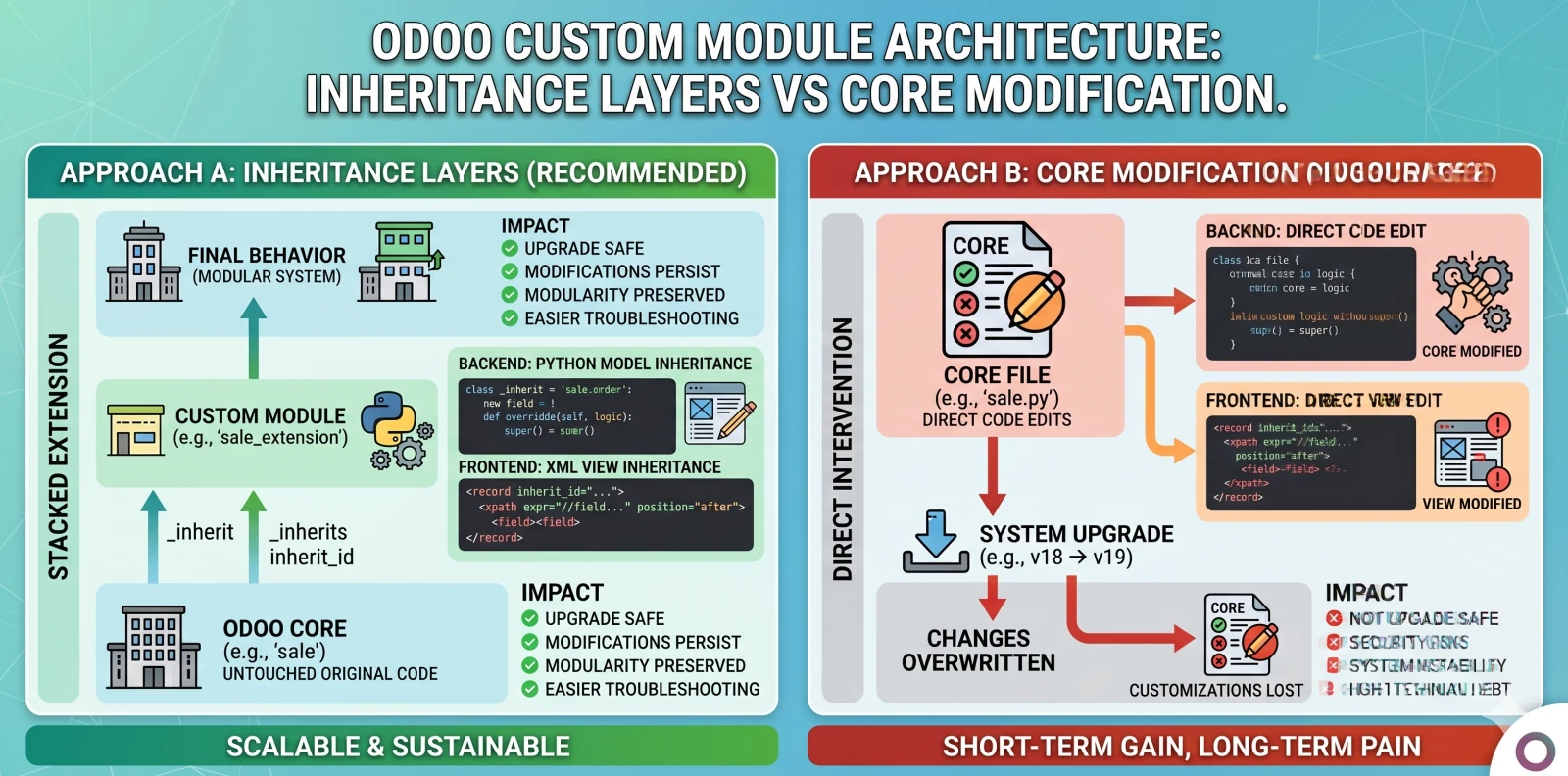
Customization depth. Standard Odoo configured well is cheap. Custom Python modules that change core behavior are expensive, to build, and to maintain through every version upgrade. The most costly projects are the ones that rebuilt Odoo instead of adopting it.
Integrations. Every external system, payment processor, Shopify or Amazon, a 3PL, a tax engine like Avalara, an existing payroll provider, is an integration with its own design, build, and error-handling cost. Integrations are also where "simple" projects quietly turn into complex ones.
Data migration. Clean data from one source system migrates cheaply. Fifteen years of QuickBooks history with duplicate vendors, inconsistent SKUs, and partial records is a project of its own. Migration cost tracks data quality, not data volume.
Number of user roles. Ten users in one role is simple. Ten users across sales, warehouse, finance, and management means more access rules, more workflows, more training tracks, and more testing paths.
Hosting: Odoo.sh vs. self-managed
Hosting is the smallest recurring number, but the choice has operational consequences.
Odoo.sh is Odoo's managed platform-as-a-service. It handles staging branches, automated backups, and the upgrade tooling, and it's priced per worker and per user, most US mid-market deployments run a few hundred to a couple thousand dollars a month. It's the path of least resistance for teams that don't want to run infrastructure.
Self-managed on AWS or Azure gives you control over region, network, and scaling, and can be cheaper at the compute level, but you own patching, backups, monitoring, and upgrades. The raw cloud bill might be $300-1,500/month for a mid-market instance; the real cost is the engineering time to run it properly. Pick this when you have compliance requirements or an existing cloud platform team. Otherwise, Odoo.sh usually wins on total effort.
Ongoing support: the 15-20% nobody budgets for
Go-live is the middle of the project, not the end. Plan for ongoing support at roughly 15-20% of the implementation value per year. On a $100K implementation, that's $15K-20K annually, covering version upgrades, bug fixes, small enhancements, user questions, and the inevitable "can it also do this" requests.
Skip support and one of two things happens: you fall behind on Odoo's annual major version (upgrades get harder and riskier the longer you wait), or your team improvises fixes that drift from the original design until the system fights you. The 15-20% isn't an upsell. It's the cost of keeping a living system healthy.
US partner vs. offshore pricing
The honest comparison most buyers want. Offshore implementation rates are lower, sometimes dramatically, and for the right scope with the right oversight, offshore delivery works.
Where offshore saves money: well-defined, configuration-heavy work with clear specs and a strong in-house product owner who can review and direct daily.
Where it costs more than it saves: ambiguous scope, US-specific accounting and tax requirements, heavy stakeholder facilitation, and integrations with US systems. Time-zone gaps, rework cycles, and communication overhead eat the rate advantage. A $60K offshore project that takes three rounds of rework and slips two months often ends up costing more, in your team's time and in delayed value, than an $85K project delivered once, correctly.
A US-based certified partner costs more per hour and is accountable in your time zone, under US contract law, with people who understand US compliance. The right answer is frequently a blend: senior US-based architecture and accountability, with delivery capacity that fits the work. NETLINKS works on exactly this model, see our Odoo implementation in the USA page for how we structure engagements.
If you're still weighing platforms before you weigh partners, our Odoo vs. NetSuite breakdown covers the total-cost picture against the most common US alternative.
Why lowball fixed bids cost the most
Here's the pattern we see repeatedly. A company collects three bids. Two land in the ranges above. One comes in at half. The cheap bid wins.
Then the change orders start. The integration "wasn't in scope." The data migration "assumed clean data." The custom report "is additional." Six months later, the cheap bid has cost more than the honest ones, and the company has a half-finished system and a damaged relationship with its vendor.
A fixed price is only meaningful against a fixed scope. That's why we sell a paid 2-4 week structured discovery before any implementation proposal. Discovery produces a documented scope, a data assessment, an integration list, and a configuration plan. Only then do we issue a firm fixed-fee proposal, one you can hold us to, because both sides know exactly what's inside it.
We deliver under ISO 12207 and ISO 27001, which means the process and the security controls behind that proposal aren't improvised.
Putting a real number together
Here's what a representative US mid-market budget looks like in year one, 40 users, 6 apps, two integrations, moderate customization, Odoo.sh hosting.
| Line item | Year-one cost |
|---|---|
| Enterprise licenses (40 users) | ~$18,000 |
| Implementation services (mid-market) | $60,000-150,000 |
| Hosting (Odoo.sh) | $6,000-18,000 |
| Ongoing support (15-20% of services) | $12,000-30,000 |
| Year-one total | ~$96,000-216,000 |
Your number depends on the five cost drivers above, which is exactly why a credible quote follows discovery rather than preceding it.
The honest bottom line
A focused Phase 1 in the US starts around $25K-60K in services. A typical mid-market rollout runs $60K-150K. Enterprise programs run $150K-500K and up. Add Enterprise licenses at $25-50/user/month, modest hosting, and 15-20% per year for support.
The cheapest bid is rarely the cheapest project. The right way to control Odoo cost isn't to find the lowest number, it's to fix the scope first, so the number means something. If you want a firm figure for your situation, a paid discovery is where it starts.