Nonprofit technology, why Odoo is replacing Blackbaud for mid-size NGOs
A comparison of Odoo and Blackbaud (Raiser's Edge, Financial Edge) for mid-size nonprofits. Where each wins, and why Odoo has momentum in the space.
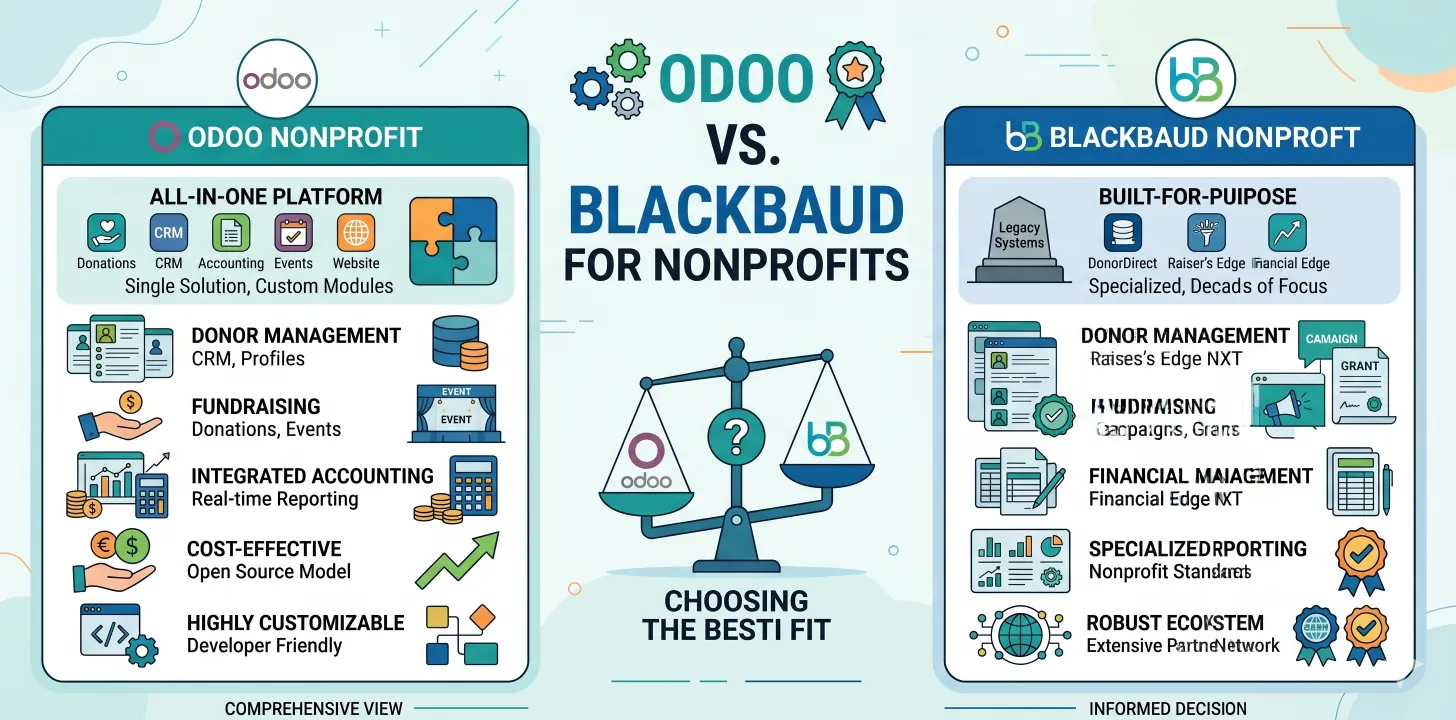
The nonprofit tech landscape
Mid-size nonprofits (20-500 staff) typically run on a tech stack that grew organically:
- Raiser's Edge or Salesforce Nonprofit Cloud for donor CRM
- Financial Edge or QuickBooks or Sage Intacct for accounting
- A custom spreadsheet for grant tracking
- A project tool (Monday, Asana) for program delivery
- Various single-purpose tools (volunteer management, event management, email marketing)
License costs add up. More importantly, the integration work between systems compounds. Board reports require manual assembly across systems. Audit prep takes weeks. Program teams and development teams work from different data.
Odoo is increasingly replacing this patchwork with a unified platform. Here's the honest comparison.
Where Blackbaud genuinely wins
1. Deep fundraising-specific features
Raiser's Edge has features that matter for large development-driven organizations:
- Sophisticated prospect research integration (iWave, WealthEngine)
- Gift aid calculation with complex regulatory handling
- Memorial gift workflows and honoree tracking
- Specific tribute and endowment management
- Donor pipeline stages adapted to major-gifts fundraising
If fundraising is your core operational engine and you're doing $10M+ in annual fundraising with a development team of 5+ people, Raiser's Edge's specialized features have real value.
2. Established ecosystem in the nonprofit world
The nonprofit technology ecosystem has grown around Blackbaud. Vendors, consultants, trainers, and best-practices communities all assume Raiser's Edge. Changing means adapting to a smaller ecosystem.
3. Regulatory and compliance features
Blackbaud has built-in tools for specific regulatory requirements, IRS 990 reporting, donor restriction tracking, specific NPO GAAP requirements. Odoo needs configuration to match.
Where Odoo wins
1. Total cost is 60-75% lower
For a mid-size nonprofit with 100 users:
| Cost category | Odoo Enterprise | Blackbaud (RE NXT + Financial Edge NXT) |
|---|---|---|
| Annual licenses | $35K-50K | $80K-150K |
| Implementation | $40K-80K | $80K-180K |
| Annual support | $15K-25K | $30K-60K |
| 3-year TCO | $180K-320K | $500K-900K |
The savings matter, for nonprofits operating on donor-restricted budgets, reducing technology TCO means more program delivery.
2. Unified platform for all operations
Odoo consolidates donor CRM, accounting, grants, HR, volunteer management, project delivery, and events into one system. Blackbaud's ecosystem is more specialized: you'd end up with RE for donors, Financial Edge for accounting, Grantmaking Cloud or a separate tool for grants, and external tools for operations.
For mid-size nonprofits, the consolidation is operationally significant.
3. Customization and flexibility
Mission-driven organizations often have unique operational patterns that Blackbaud's more-opinionated platform fights against. Odoo's flexibility accommodates them without requiring vendor customization services.
4. Open architecture and data ownership
Nonprofits often have 10-20+ year data retention needs. Odoo's open architecture and PostgreSQL database mean your data lives on your terms. Blackbaud's closed platform creates data-portability questions.
Where the comparison depends on you
Your fundraising sophistication
- Major gifts-driven organization with $10M+ annual fundraising, 5+ development staff, prospect research partnerships → Blackbaud's specialized features likely worth the premium
- Operations-driven organization, diversified revenue, moderate fundraising → Odoo's unified platform is stronger fit
- Grant-focused nonprofit (institutional donors, government contracts) → Odoo (grant lifecycle is first-class)
Your team's tech comfort
- Team accustomed to Blackbaud's workflows → migration friction is real
- Team frustrated with fragmented tools → Odoo's consolidation addresses this directly
Your regulatory context
- Heavy US federal contracting → both work with proper configuration
- International operations with multi-jurisdiction compliance → Odoo's multi-company and multi-currency native capability is stronger
- Specific regulatory tools (SORP for UK, etc.) → evaluate both carefully
Real-world comparison: a mid-size international NGO
A global NGO with:
- 180 staff across 12 countries
- $35M annual budget
- Donor base: 40% institutional grants (USAID, EU, foundations), 30% major gifts, 30% individual donors
- Outgrowing Raiser's Edge + QuickBooks + Excel-based grant tracking
Odoo is genuinely stronger for this organization because:
- Multi-entity, multi-currency support is native (vs Blackbaud add-ons)
- Grant lifecycle from application to reporting fits Odoo's project + accounting integration
- Operations modules (procurement, HR, project delivery) consolidate many currently-separate tools
- Cost savings fund more program delivery
Three-year TCO: $280K Odoo vs $750K Blackbaud ecosystem.
Real-world comparison: a development-driven foundation
A foundation with:
- 45 staff
- $80M annual giving
- Major donor and endowment focus
- Prospect research partnerships, major-gifts culture
Blackbaud is genuinely stronger here because:
- Major-gifts pipeline management with prospect research integration is mature in Raiser's Edge
- Endowment accounting with restriction tracking is Blackbaud's specialty
- Donor engagement workflows specific to major gifts are more polished
The cost premium is justified by the fit.
Migrating from Blackbaud to Odoo
If the evaluation lands on Odoo, migration from Blackbaud is moderate-complexity work:
- Timeline: 14-22 weeks depending on scope
- Cost: $80-180K typical for mid-size NGOs
- Key work: Donor data migration (RE to Odoo contacts with giving history), gift and pledge data, fund structure mapping, grant records, historical reports
We preserve all donor history and giving patterns during migration. Major-gifts workflows are reconstructed in Odoo; if some specific Blackbaud features don't translate cleanly, we either build them as custom modules or recommend keeping Raiser's Edge for those specific use cases.
Conclusion
Blackbaud is excellent for its intended use case, fundraising-mature large organizations. Odoo is a strong alternative for mid-size nonprofits where unified operations matter more than specialized fundraising features. Evaluate based on your specific fundraising sophistication, team comfort, and operational patterns.
If you're a nonprofit evaluating this choice, talk to us. We'll give you an honest read on whether Odoo or Blackbaud fits better for your situation.
Related reading: Nonprofits industry page · Real cost of Odoo implementation · Odoo for multi-entity groups