Professional services firms, retiring your PSA tool in favor of Odoo Project
Why mid-market services firms are consolidating from dedicated PSA tools (Kantata, Deltek, BigTime) onto Odoo. Economics, migration, and trade-offs.
Why services firms have a PSA problem
Professional services firms (consulting, accounting, legal, architecture, engineering, agency, IT services) have a structural tension in their tech stack. Project delivery wants a PSA tool that understands tasks, timesheets, utilization, and project profitability. Finance wants an ERP that understands GL, AR, AP, and revenue recognition. Most firms use both, and spend weeks reconciling them monthly.
The reconciliation problem compounds:
- Billable rates in PSA diverge from list rates in ERP
- Project codes get created in one system without the other
- WIP in PSA doesn't match revenue in ERP
- Utilization reports from PSA don't align with financial profitability from ERP
- When finance reports 42% gross margin and delivery reports 48%, nobody trusts either
For mid-market services firms (50-500 employees), this tax is real, often 0.5-1 FTE of controller time monthly, plus ongoing confusion about true project economics.
What Odoo Project + Accounting replaces
Odoo Project + Accounting + Timesheets + Subscriptions + CRM is one system with one database. Time entered on a project updates project WIP and project labor cost simultaneously. Invoicing a milestone posts revenue to the project and GL in one transaction. Profitability reports run against actual GL, they're not a reconciliation, they're the source.
This architecture covers 80-90% of what dedicated PSAs do. What's missing:
- Sophisticated resource optimization algorithms (Kantata's strength)
- Specific industry workflows for engineering/architecture firms (Deltek's strength)
- Advanced skills matching (Workfront, BigTime strength)
For most mid-market services firms, the missing 10-20% doesn't justify the price premium and integration overhead of specialized PSA tools.
Cost comparison
For a 120-person services firm:
| Cost category | Odoo Enterprise | Kantata | Deltek Vantagepoint |
|---|---|---|---|
| Annual license (120 users) | $45K-70K | $100K-140K | $120K-180K |
| Initial implementation | $60K-120K | $120K-250K | $200K-400K |
| Annual support | $24K-48K | $48K-96K | $60K-120K |
| PSA-to-ERP integration | N/A (not needed) | $15K-40K | $15K-40K |
| 3-year TCO | $250K-450K | $700K-1.2M | $850K-1.5M |
Substantial savings, plus the eliminated reconciliation overhead.
Real outcomes from our services clients
Across 20+ services firm implementations we've seen consistent patterns:
+4 to 8 points of gross margin in Year 1
Real-time project profitability surfaces unprofitable projects before they're already done. Teams adjust scope, add change orders, or kill losing projects earlier. Gross margin improvement from 42-44% to 46-50% is typical.
95%+ timesheet compliance (up from 75-80%)
Calendar auto-capture and integrated reminders drive compliance up. Finance gets clean data without chasing.
Month-end close from 5 days to 3 days (or 7 to 4)
One-system reconciliation eliminates the PSA-to-ERP matching exercise that dominated close weeks.
Resource forecasting visibility 8-12 weeks out
Utilization forecasts combining booked work and pipeline. Hiring and bench management decisions made on data rather than gut.
Single client view across sales, delivery, and finance
CRM, project, and accounting data live in one profile. Account reviews, escalations, and renewals backed by complete context.
When dedicated PSA is still right
Very large services firms (500+ employees)
At larger scale, specialized PSA's resource-optimization algorithms and workflows start earning their premium.
Specialized verticals
Architecture/engineering firms with deep Deltek-specific workflows for project phases, change orders, and licensing fee tracking sometimes stay on Deltek.
Firms with mature PSA investments
If you've deeply customized Kantata or Deltek over 5+ years, migration has real switching cost. Evaluate whether Odoo savings justify it.
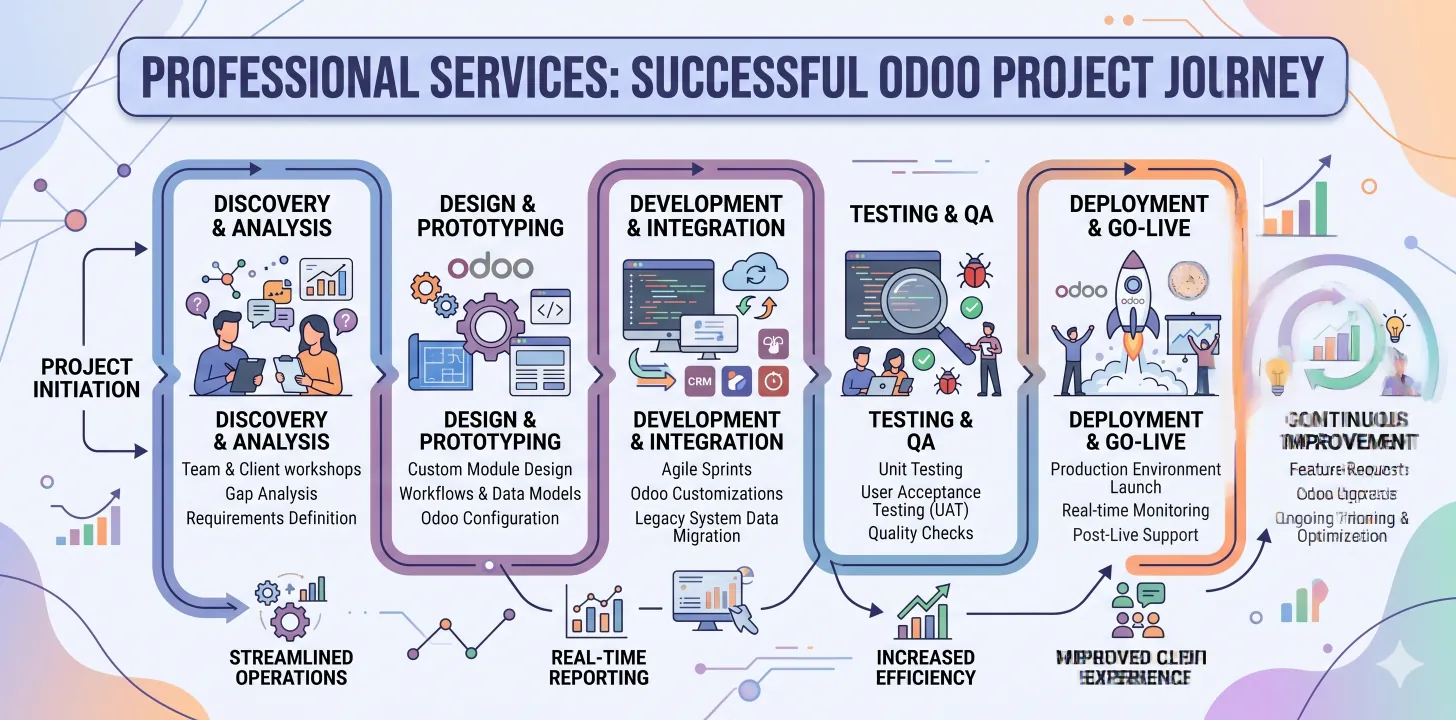
Migration playbook for services firms
Typical migration timeline:
Weeks 1-3: Discovery
- Current-state process mapping (quote-to-cash, project lifecycle, billing, utilization reporting)
- Data audit (clients, projects, timesheets, rate cards, WIP)
- Configuration design
Weeks 4-8: Configuration
- Odoo Project + Accounting setup
- Rate cards, billing rules, approval workflows
- Resource planning configuration
- Custom reports matching current management reports
Weeks 9-11: Data migration
- Client, project, and contact data from existing PSA
- Historical timesheet data for 12-18 months (usually sufficient)
- Open WIP and unbilled revenue
- Historical project financial data for analysis
Weeks 12-14: Parallel run (optional)
- Both systems running; daily reconciliation
- Training during this period
Weeks 15-16: Cutover + hypercare
- Cut over weekend, hypercare for 4-6 weeks
Common gotchas
Rate card translation
PSA rate structures often have layered complexity (role × level × client × market). Migrating to Odoo requires simplification or custom rate logic.
Custom billing rules
Fixed-fee with milestones, T&M with caps, retainer burn-down, hybrid arrangements all need explicit configuration in Odoo.
Resource skills and availability
If your PSA has detailed skill tracking and availability management, plan for configuration effort in Odoo to match.
Client expectations around project portal
Clients accustomed to your PSA's client portal may need an adaptation period for Odoo's portal.
Conclusion
Dedicated PSA tools are excellent for specific contexts. For most mid-market services firms, Odoo Project + Accounting covers 80-90% of needs at substantially lower cost, with the significant bonus of eliminating PSA-to-ERP reconciliation tax.
If you're running a mid-market services firm and feel the pain of fragmented PSA and ERP, talk to us. We'll evaluate whether consolidation on Odoo makes sense.
Related reading: Professional services industry page · Odoo for multi-entity groups · Real cost of Odoo implementation