Field service operators, from dispatch to invoice on one system
How HVAC, plumbing, electrical, and facility services operators consolidate dispatch, mobile workforce, service contracts, and invoicing on Odoo Field Service.
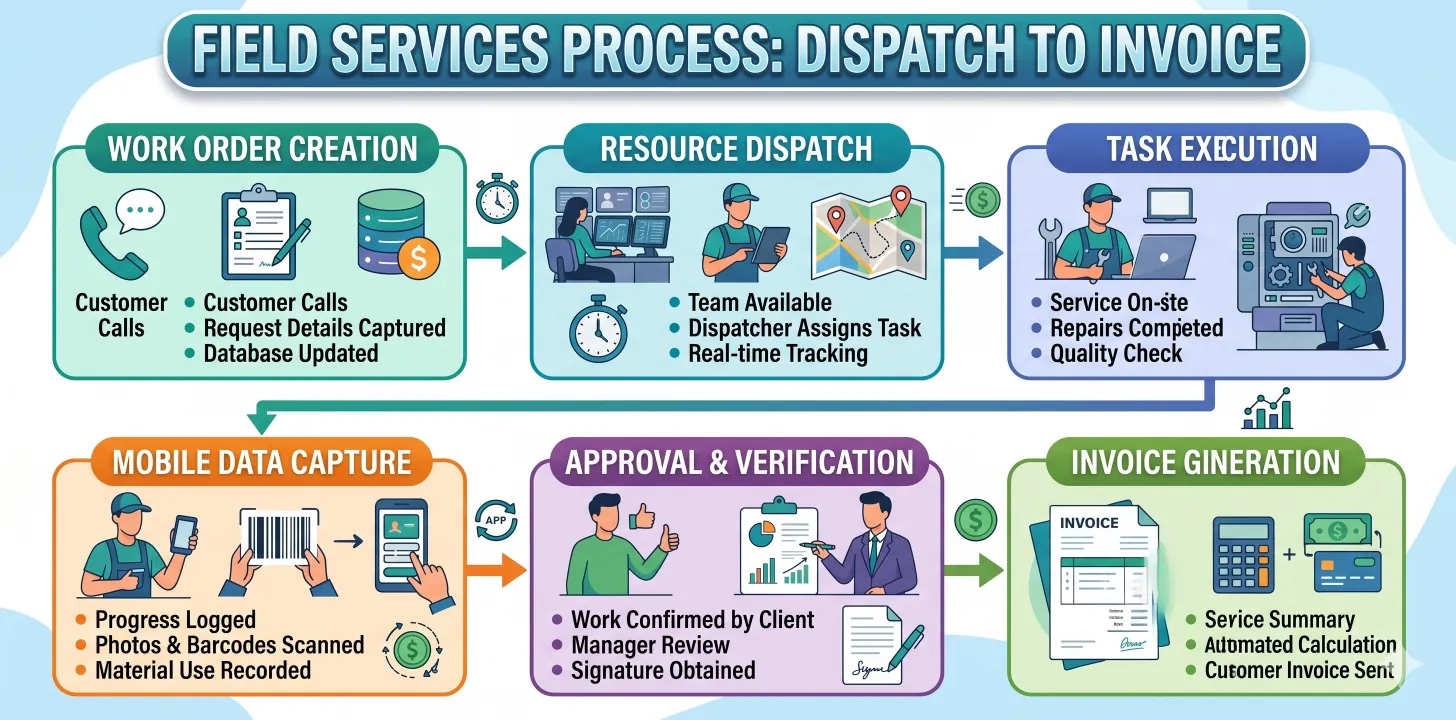
The field service stack problem
Most mid-market field service operators (HVAC contractors, plumbing firms, facility maintenance companies, home service aggregators) run on stacks that accumulated organically:
- ServiceTitan / Jobber / Tradify for dispatch and mobile
- QuickBooks / Sage for accounting
- A CRM maybe (Pipedrive, HubSpot)
- Fleet management tool
- Custom spreadsheet tracking recurring contract revenue and renewals
The tools work individually; the integration between them doesn't. Consequences compound:
- Truck inventory isn't accurate because parts consumed on jobs aren't tracked in the accounting system until the office enters them a week later
- Contract revenue forecasting is a monthly spreadsheet exercise
- Technician utilization is hard to measure accurately, time capture in dispatch tool, payroll in accounting
- Service contract profitability is unclear until quarterly review
- On-site invoicing and payment collection happens (or doesn't) inconsistently
What Odoo Field Service provides
Odoo Field Service + Inventory + Accounting + HR in one system:
- Dispatch: route optimization, skills matching, SLA-driven scheduling
- Mobile app: techs take jobs, capture photos, get signatures, clock time from their phone (works offline)
- Service contracts: recurring contracts with scheduled preventive maintenance, SLAs, contract profitability
- Van inventory: each vehicle is an inventory location; parts consumed on jobs decrement van and trigger replenishment automatically
- On-site invoicing: generate and email invoice before tech leaves the site
- Analytics: first-time fix rate, tech utilization, contract profitability
One system, one database, one source of truth. Dispatch decisions backed by real financial visibility. Tech performance in context of actual revenue generation.
Cost comparison
For an operator with 50 technicians:
| Cost category | Odoo | ServiceTitan | Jobber |
|---|---|---|---|
| Annual license (50 techs) | $25K-40K | $180K-300K | $50K-90K |
| Implementation | $40K-80K | $80K-200K | $25K-60K |
| Annual support | $12K-24K | Included (premium tier) | Standard |
| 3-year TCO | $130K-220K | $620K-1.1M | $200K-360K |
ServiceTitan has premium features for residential HVAC operators that justify its pricing for certain high-ticket residential businesses. For most field service operators, Odoo is economically stronger.
Real outcomes we've seen
Residential HVAC contractor (45 technicians)
- Replaced QuickBooks + ServiceFusion + custom van inventory spreadsheet
- Van inventory accuracy: 68% → 94%
- Time from job completion to invoice: 3-5 days → same day
- Service contract renewal rate: +8 percentage points (automated reminders and contract profitability visibility)
- 3-year payback: 14 months
Commercial facility services operator (80 technicians, 200+ contracts)
- Replaced Jobber + Sage + custom contract spreadsheet + Excel dispatch
- Contract profitability visible by contract in real time
- Identified 3 unprofitable contracts that had been renewing without review
- Dispatched 22% more work per day through better route optimization
- 3-year payback: 11 months
Implementation realities
Offline capability is critical
Techs work in basements, crawlspaces, mechanical rooms, remote sites. The mobile app must work offline. Odoo's does. Test this explicitly during evaluation, any field service tool that requires connectivity is not viable for real field work.
Dispatch complexity varies
Simple same-day dispatch is straightforward. Complex multi-day scheduled maintenance, urgent break-fix injection, skill-based routing, and service-level agreements add complexity. Odoo's native dispatch handles most cases; for sophisticated routing (large fleets, urban density) we sometimes integrate OptimoRoute or Onfleet while keeping Odoo as system of record.
Van inventory needs real discipline
The gains from van inventory tracking only materialize with operational discipline: barcode scanning, accurate parts lists per vehicle, cycle counting. Plan for 60-90 days of adjustment period.
Service contract math needs configuration
Different operators price contracts differently: flat-rate, includes-parts, tiered by coverage, commercial SLAs with penalty clauses. Configure this carefully during implementation.
Integrations that matter
Fleet tracking
Odoo integrates with most GPS fleet platforms (Verizon Connect, Geotab, Samsara) for real-time vehicle location driving dispatch decisions.
Payment processing on-site
Stripe Terminal, Square, and other mobile payment options for tech-captured payments at job completion.
Customer communications
Two-way SMS integration (Twilio) for appointment reminders, tech-on-the-way notifications, and post-service survey.
Accounting (built-in)
Native. Jobs become invoices, time becomes labor cost, parts become COGS, all in one system.
Typical implementation timeline
- Weeks 1-2: Discovery, current-state process mapping, contract structures, data audit
- Weeks 3-6: Configuration, dispatch rules, contract templates, mobile workflows, inventory setup
- Weeks 7-9: Data migration, customers, contracts, open jobs, historical data
- Weeks 10-11: Parallel run with a subset of technicians
- Weeks 12-13: Full rollout + hypercare
Total: 13 weeks typical for mid-market operators.
Conclusion
Field service operators consolidating onto Odoo eliminate the operational tax of fragmented systems, van inventory drift, contract profitability confusion, delayed invoicing, utilization guesswork. For most mid-market operators, the economics and operational gains are compelling.
If you're running field services on a fragmented stack and the pain is real, talk to us.
Related reading: Trades & field services industry page · Real cost of Odoo implementation · Manufacturing integration patterns