NetSuite to Odoo: a 3-year total cost of ownership breakdown
A line-by-line, three-year TCO comparison for a 100-user US mid-market company: NetSuite subscription, per-user fees, add-on modules, and renewal uplift versus Odoo Enterprise plus a one-time migration. Includes where NetSuite genuinely wins and a payback calculation.
Introduction: the number that actually matters
The question we get from finance leaders evaluating a NetSuite-to-Odoo move is never "which ERP has more features." It is "what does each one cost me over the next three years, all in, and when do I break even?" That is the only number that survives a board meeting.
So this post does the arithmetic. We model a hypothetical US mid-market company, 100 users, multi-entity but not global, standard accounting plus inventory, light manufacturing, and a sales team that lives in CRM, and we walk every cost line for three years. NetSuite on one side, Odoo Enterprise on the other. We include the part most vendor comparisons hide: the upfront cost of actually moving your data and processes from one system to the other.
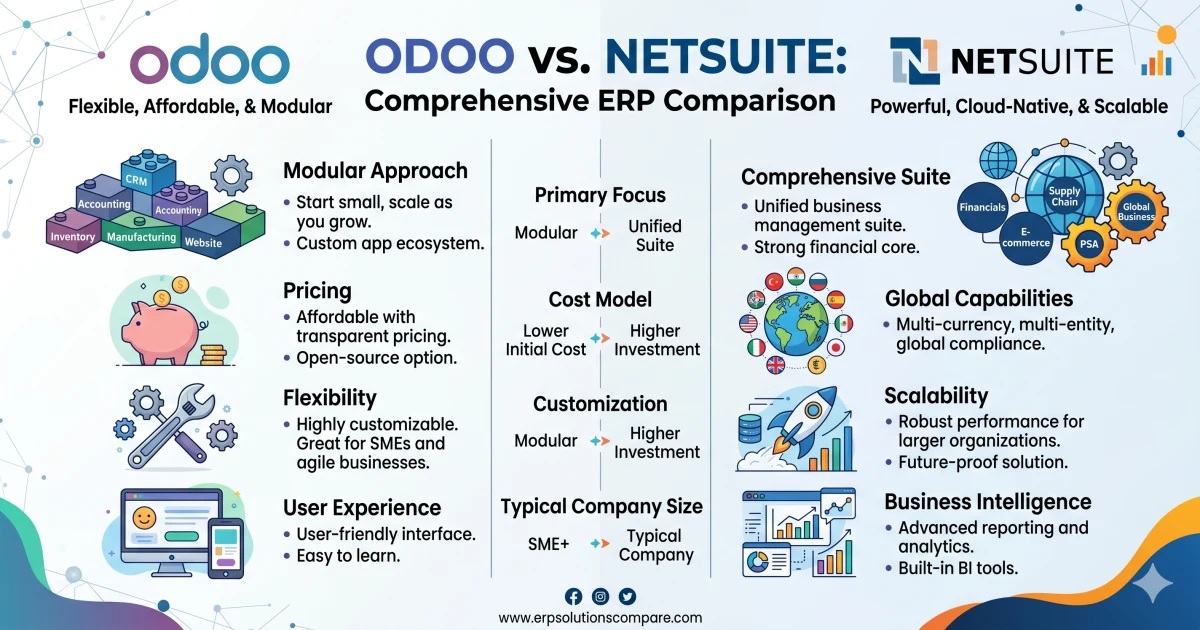
We are a certified Odoo partner, and we have migrated NetSuite customers to Odoo. We are also going to tell you, plainly, where NetSuite is the better keep. The goal here is a defensible model, not a sales pitch. For a feature-and-fit view rather than a cost view, see our Odoo vs NetSuite comparison.
Methodology and assumptions
A TCO comparison is only honest if its assumptions are visible. Here are ours.
The company. 100 named users. Headquartered in the US, two legal entities, USD reporting. Modules in scope: financials/accounting, inventory and warehouse, purchasing, sales, CRM, basic manufacturing, and project. No heavy custom development beyond what a typical mid-market rollout needs, a handful of integrations and report customizations.
The time horizon. 36 months from go-live, plus the implementation period that precedes it. We count implementation as a year-0 capital line and subscriptions as recurring operating lines across years 1-3.
What we include. Subscription/license fees, per-user fees, add-on modules, sandbox/test environments, premium support, implementation services, customization, hosting, and renewal increases. What we exclude: internal staff time (roughly equal across both, so it cancels), and one-off hardware (both are cloud).
Currency and discounts. USD throughout. We model NetSuite at typical, not best-case, discounting, vendors discount aggressively in year 1 and recover it at renewal, which is exactly why year 3 matters.
A three-year window is deliberate. NetSuite's economics look reasonable in year 1 and reveal themselves at the first and second renewal. Modeling only year 1 is how companies get surprised.
NetSuite: where the money goes
NetSuite is sold as a base platform plus per-user licenses plus modules, almost always on an annual contract. The published mechanics, at US mid-market scale:
- Base platform license, commonly around $999/month as a starting point, frequently higher once edition and tier are set.
- Per-user fees, roughly $100-$150 per user per month. At 100 users that line alone is the dominant cost.
- Add-on modules, SuiteAnalytics for real reporting, SuitePeople for HR, SuiteCommerce if you sell online, advanced inventory, and so on. Each carries its own annual fee.
- Sandbox, a separate paid environment for testing and training.
- Premium support, meaningful response SLAs are a paid tier, often priced as a percentage of license.
- Implementation, delivered through NetSuite or a SuiteCloud partner; for this scope, a six-figure engagement.
- Renewal uplift, this is the line nobody quotes upfront. Year-1 promotional pricing commonly resets 50-80% higher at renewal, and per-user costs compound as you add seats.
The renewal mechanic is not a horror story we invented; it is the standard subscription playbook. The discount that wins the deal in year 1 is the discount that disappears in year 2 and 3.
Odoo Enterprise: where the money goes
Odoo's cost structure is shorter, and that is most of the point.
- Subscription, Odoo Enterprise runs roughly $25-$50 per user per month depending on plan and apps. No separate base-platform tax stacked on top of seats.
- Implementation, for a 100-user, multi-module rollout, a real engagement: discovery, configuration, integrations, testing, training. This is where most of your year-0 spend lives.
- Migration, the one-time cost of moving from NetSuite specifically: extracting your data, mapping it to Odoo's model, cleansing, and reconciling. We give it its own line below because pretending it is free would make this model dishonest.
- Customization, the modules and reports that match your process. Odoo's apps are standard Python you own, which keeps this bounded.
- Hosting, Odoo.sh (the managed Odoo platform) for staging, production, and automated backups, billed by worker and storage.
- Support, included in Enterprise for bug fixes; functional support is via your partner.
For how we de-risk the data move itself, see Odoo migration from NetSuite.
The 3-year side-by-side
Here is the model. Ranges reflect light-to-heavier scope within the same 100-user company. Figures are USD, rounded.
| Cost line | NetSuite (3-yr) | Odoo Enterprise (3-yr) |
|---|---|---|
| Base platform license | $36K-$60K | included in per-user |
| Per-user subscription (100 users) | $1.08M-$1.62M | $90K-$180K |
| Add-on modules (analytics, HR, commerce) | $120K-$300K | included / minor |
| Sandbox + test environments | $30K-$60K | included in hosting |
| Premium support | $90K-$180K | included (Enterprise) |
| Hosting (Odoo.sh) | n/a (SaaS) | $18K-$45K |
| Subscription + support subtotal | $1.36M-$2.22M | $108K-$225K |
| Implementation (year 0) | $150K-$350K | $150K-$350K |
| Customization / integrations | $80K-$200K | $80K-$200K |
| Migration from NetSuite (year 0, one-time) | n/a | $120K-$300K |
| Year-3 renewal uplift (50-80% on subscription) | $400K-$650K | $0 (flat) |
| 3-year cumulative TCO | $2.1M-$3.0M | $0.95M-$1.4M |
A few honest notes on reading this table. The migration line is real money and it is on the Odoo side only, moving costs you something, staying does not. The renewal-uplift line is the single biggest reason the gap widens over three years: Odoo's per-user cost stays flat while NetSuite's compounds and resets upward. And both systems carry similar implementation and customization spend, because the hard part of any ERP project is your processes, not the badge on the login screen.
Where NetSuite genuinely wins
If this were a one-sided pitch you would stop trusting it, and you would be right to. There are real cases where NetSuite is the better system and the migration is not worth it.
Advanced revenue recognition. If you run complex, multi-element revenue arrangements under ASC 606, subscription bundles, usage-based billing, percentage-of-completion across long contracts, NetSuite's rev-rec engine is mature and battle-tested. Odoo can do subscription and deferred revenue well, but at the most advanced end NetSuite has more out-of-the-box depth.
OneWorld multi-subsidiary depth. A genuinely global business, many subsidiaries, many currencies, intercompany eliminations, statutory reporting in a dozen jurisdictions, is NetSuite OneWorld's home turf. Odoo handles multi-company and multi-currency, but the deepest consolidation scenarios favor NetSuite.
Oracle-ecosystem alignment. If your parent runs Oracle, or you are committed to the Oracle data and analytics stack, NetSuite's native alignment has real value that a TCO table does not capture.
The honest test: if advanced rev-rec, deep multi-subsidiary consolidation, or Oracle alignment are core to how your business actually runs, the cost gap may be worth paying. If they are not, and for most 100-user mid-market firms they are not, the math points the other way.
Payback period and the migration question
The decision comes down to payback: how long until the savings cover the one-time cost of moving.
Take the midpoints. NetSuite's three-year run-rate, including renewal uplift, sits near $2.5M. Odoo's three-year total, migration included, sits near $1.15M. The one-time migration and implementation premium you pay to switch is recovered by annual subscription savings that commonly run $400K-$600K per year at this user count.
At those savings, the migration line pays for itself inside the first 8-14 months after go-live, and every month after that is net positive. Over three years the cumulative saving funds a full-time systems team several times over.
The risk in switching is not financial, it is execution. A botched data migration costs far more than any license. That is why we run NetSuite-to-Odoo moves as a staged sequence, extract, map, cleanse, test, reconcile, UAT, rehearse the cutover, then go live, under ISO 12207 and ISO 27001 controls, so the cutover is rehearsed before it is real. NETLINKS has done this work: 20-plus years in business from our Fairfax, Virginia headquarters, 50-plus Odoo implementations including a 500,000-employee national-government rollout, and NetSuite customers already migrated to Odoo.
If you want the model filled in with your actual seat count, modules, and quotes, our Odoo migration services team will build it with you before you commit to anything.
Key takeaways
- For a 100-user US mid-market firm, three-year TCO is roughly $2.1M-$3.0M on NetSuite versus $0.95M-$1.4M on Odoo Enterprise, migration included.
- The gap is driven by per-user pricing that compounds and renewal uplifts of 50-80%, against an Odoo subscription that stays flat.
- Migration is a real upfront cost ($120K-$300K here) and should be modeled as its own line, not hidden.
- NetSuite still wins on advanced rev-rec, OneWorld consolidation depth, and Oracle alignment. If those are core, the switch may not pay off.
- Payback on a well-run migration typically lands inside 8-14 months. The dominant risk is execution, not economics, so the migration method matters more than the license price.