Odoo vs NetSuite, a mid-market ERP comparison that addresses the trade-offs
A detailed comparison of Odoo Enterprise and Oracle NetSuite for mid-market companies. License economics, operational fit, customization surface, and the specific contexts where each is the better bet.
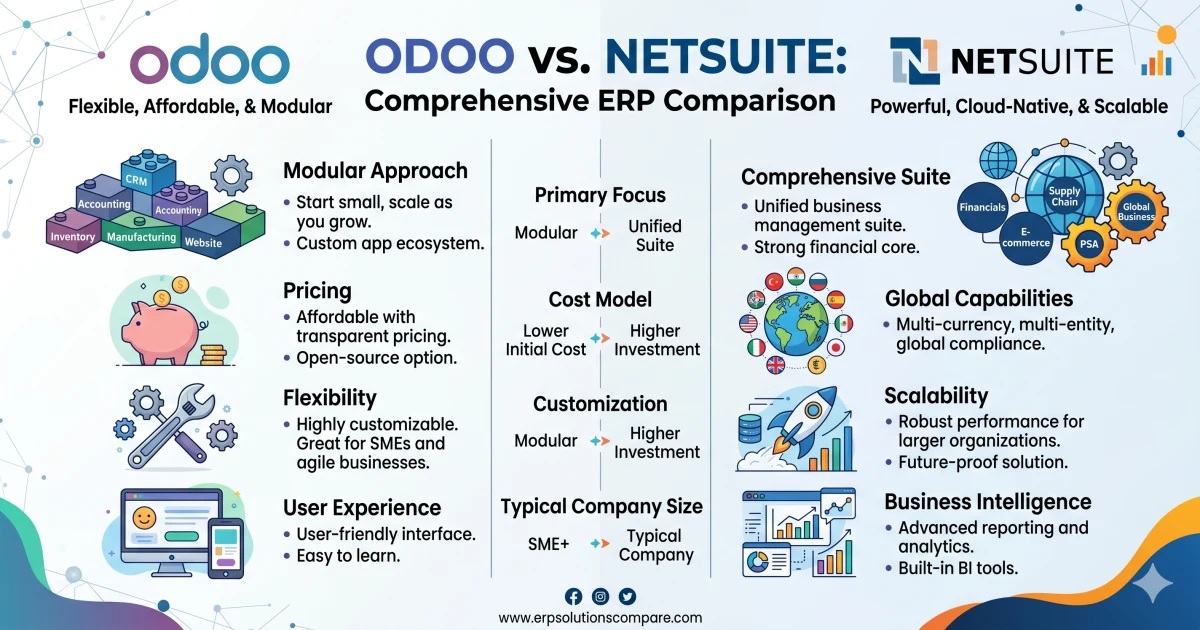
Introduction
NetSuite is Oracle's cloud ERP, born in SaaS, subscription-native, and deeply entrenched in mid-market SaaS. Odoo is the open-source alternative growing fastest in the same segment. They're real competitors, and the choice drives substantially different cost and operational profiles.
This piece compares the two across the dimensions that actually matter when you're making the decision. We've migrated clients both onto Odoo from NetSuite and occasionally back to NetSuite when the fit genuinely wasn't there.
The two products in one paragraph each
NetSuite is Oracle's cloud ERP, originally designed for SaaS and subscription businesses and now covering broader mid-market. Strong on multi-subsidiary consolidation (OneWorld), ASC 606 rev-rec, and pre-built verticals (SuiteSuccess). Customization via SuiteScript (JavaScript SDK) and SuiteFlow. Pricing is subscription-based and higher than alternatives; architecture is closed.
Odoo Enterprise is the paid edition of the world's most-deployed open-source ERP. Broader module coverage (40+ modules), open architecture, Python-based customization, and substantially lower TCO. Deployment options: Odoo.sh managed cloud, self-hosted on AWS/GCP/Azure, or on-premise.
Where NetSuite genuinely wins
1. SaaS with complex ASC 606
NetSuite was built for SaaS from day one. Its rev-rec under ASC 606 is gold standard for:
- Multi-element arrangements (software + services + support bundles) with standalone selling price allocation
- Ramp deals with tiered pricing over multiple periods
- Usage-based billing with tiered, graduated, or volume rate cards
- Sophisticated deferred revenue waterfalls
Odoo's subscriptions handle most cases well, but for genuinely complex ASC 606 edge cases (SaaS with bundled hardware + software + services + support + professional services), NetSuite's rev-rec is more mature out of the box.
2. Global SaaS with 10+ subsidiaries
OneWorld is excellent for global SaaS with complex intercompany flows. For 15-40 subsidiaries across countries, currencies, and legal entities, with transfer pricing and intercompany allocation, NetSuite is more elegant than Odoo.
Odoo handles 2-15 subsidiaries cleanly. NetSuite's advantage kicks in specifically at large-scale global complexity.
3. Pre-built industry solutions
SuiteSuccess is NetSuite's productized methodology with pre-configured verticals for software, wholesale distribution, manufacturing, services, and nonprofits. For companies that fit a vertical closely, implementation accelerates to 100 days.
Odoo has similar starter kits through partners but they're less standardized. If your business exactly fits a SuiteSuccess vertical, there's a real speed advantage.
Where Odoo wins
1. TCO is 50-70% lower
At 100-user scale:
| Cost category | Odoo Enterprise | NetSuite |
|---|---|---|
| Annual license (100 users) | $60K-80K | $120K-180K |
| Implementation | $80K-150K | $150K-400K |
| Customization hourly rate | $120-180 | $150-300 |
| Annual support retainer | $48K-120K | $72K-180K |
| 3-year TCO | $400K-800K | $900K-1.8M |
The cost delta is substantial and compounds over time.
2. Customization flexibility
Odoo customization is Python against a well-documented ORM. Forkable modules, extendable classes, clean engineering practices. Python developer supply is deep.
NetSuite customization is SuiteScript 2.x (JavaScript SDK) and SuiteFlow. Smaller ecosystem, more expensive developers ($200-300/hour for certified specialists), many customizations require vendor review. Fundamentally more constrained.
3. Module breadth without marketplace assembly
Odoo native modules that NetSuite sells as add-ons or relies on partners for:
- E-commerce, Odoo native; NetSuite SuiteCommerce as expensive add-on
- Marketing automation, Odoo native; NetSuite requires Eloqua integration
- CRM, Built-in; NetSuite CRM often supplemented with Salesforce
- POS, Odoo POS first-class; NetSuite requires RetailPro
- HR/payroll, Odoo native; NetSuite requires SuitePeople (limited)
4. Deployment flexibility
Odoo runs on Odoo.sh, self-hosted cloud, or on-premise. Your data lives where you put it. NetSuite is exclusively Oracle-hosted. For data residency, sovereignty, or compliance requirements, NetSuite's closed hosting can block deals.
The real cost of a closed ERP isn't the license fee. It's the compound price you pay every time you want to integrate with something new, customize something non-standard, or move off the platform.
The SuiteScript tax
One of the largest hidden costs of NetSuite is customization. Every non-standard workflow involves SuiteScript development. Certified developers bill $150-300/hour; in-house hires are hard to recruit and retain.
Over three years, a typical mid-market NetSuite customer spends $100K-400K on SuiteScript for features that in Odoo would be standard Python work at lower rates, or included in out-of-the-box configuration. This doesn't show up in the initial sales pitch, it accumulates in years 1-3.
Two real-world comparisons
A B2B SaaS company (180 employees, $28M ARR)
Multi-element contracts, ASC 606 complexity, 7 legal entities, Salesforce + Gainsight + Stripe integrations.
NetSuite is genuinely stronger here: ASC 606 complexity beyond Odoo's native capability, mature OneWorld consolidation, well-trodden Salesforce integrations, SuiteSuccess Software vertical fits.
3-year TCO: ~$1.1M NetSuite vs ~$600K Odoo with custom rev-rec. The $500K premium is justified by complexity reduction.
A US distributor (90 employees, $40M revenue)
Product business, single entity with 3 warehouses, outgrowing QuickBooks + Shopify.
Odoo is obviously right: No ASC 606, single entity, native e-commerce and B2B portal, no SuiteScript development for standard workflows.
3-year TCO: ~$850K NetSuite vs ~$320K Odoo. The NetSuite premium buys nothing this distributor needs.
Decision framework
Lean NetSuite if: SaaS with complex ASC 606 · Multi-subsidiary global (10+ entities) · Auditors require NetSuite-grade rev-rec · SuiteSuccess fits your vertical
Lean Odoo if: Product, distribution, manufacturing, or services business · 1-10 entities · Cost sensitivity is real · Architectural openness matters · Customization requirements will compound
Migrating from NetSuite to Odoo
We've done this migration several times. Observations:
- Data migration is moderate complexity, NetSuite export covers essentials; SuiteScript customizations need redesign for Odoo.
- Timeline: 14-22 weeks for full migration with parallel operations.
- ROI case clears within 18-24 months on license savings alone.
- Cultural shift is real, teams accustomed to vendor-managed customization adapt to an ownership model.
Conclusion
NetSuite is excellent for specific use cases. Odoo is equally excellent for broader mid-market at significantly lower cost. Neither is universally better.
Make the decision by writing down actual business requirements, not by comparing marketing feature matrices. For most mid-market product, distribution, and services companies, Odoo is the stronger choice. For SaaS companies with deep rev-rec complexity, NetSuite earns its premium.
If you want help evaluating, talk to us.
Related reading: Odoo vs SAP Business One · QuickBooks to Odoo migration playbook · Real cost of Odoo implementation