Odoo Enterprise vs Community, when the license fee is worth it
A feature-by-feature and economic comparison of Odoo Enterprise (paid) vs Odoo Community (open-source, free). When each is the right choice.
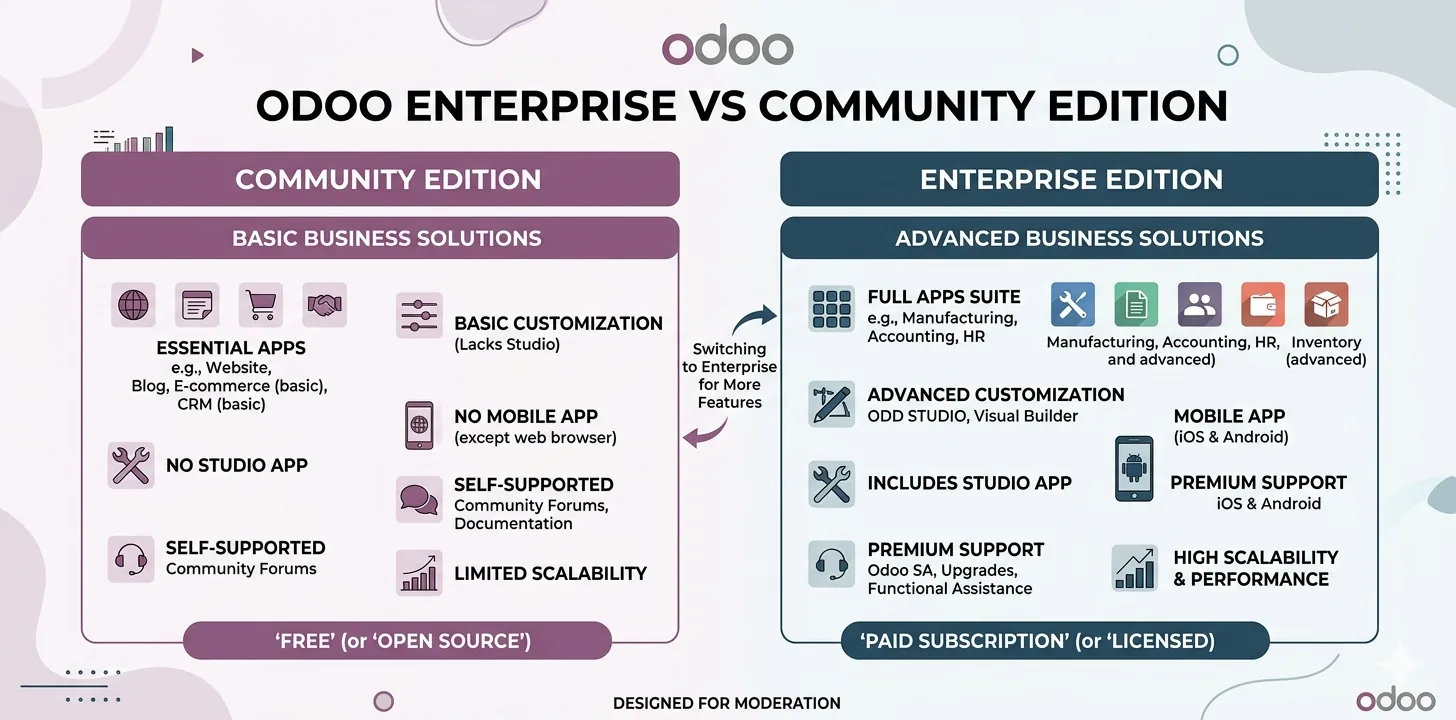
The two editions explained
Odoo is both an open-source project and a commercial product.
Odoo Community is the free, open-source edition. AGPLv3 licensed. Available at github.com/odoo/odoo. You can download, deploy, customize, and run it without paying Odoo SA anything. Covers the core functional modules (Accounting, CRM, Sales, Inventory, Purchasing, HR, Projects, Manufacturing) at a reasonable quality level.
Odoo Enterprise is the paid commercial edition. Per-user-per-month subscription. Includes everything in Community plus Enterprise-only modules (Studio, advanced features in accounting, quality, field service, subscriptions, and others), plus Odoo SA commercial support and SLAs.
What Enterprise adds
Enterprise-only modules
- Studio, drag-and-drop customization tool for fields, forms, reports, automations
- Quality, full QA workflow for manufacturing
- Field Service, dispatch, mobile workforce, service contracts
- Subscriptions, recurring billing with proration and dunning
- Planning, advanced resource planning (for services firms)
- Sign, built-in electronic signature
- Accounting Reports, advanced financial reports (cash flow, tax reports, consolidation)
- Helpdesk, ticket management
- Marketing Automation, sophisticated email and campaign automation
- IoT Integration, factory-floor hardware integration
Enhanced features in Community modules
- Accounting: Automatic bank statement import, advanced reconciliation, tax reports for 50+ jurisdictions, consolidation
- Manufacturing: Better shop-floor views, MRP-II features, work-center routing
- Inventory: Advanced warehouse routing, replenishment rules, cross-dock operations
Commercial support
- Issue response SLAs (especially at higher Odoo.sh tiers)
- Access to Odoo SA engineering for escalations
- Certified partner networks with established quality
Odoo.sh managed cloud
Enterprise subscribers get access to Odoo.sh (Odoo's managed cloud platform). Community users can self-host but don't have access to Odoo.sh.
Security and compliance
- SOC 2 Type II certification (Enterprise/Odoo.sh)
- GDPR compliance tooling
- More active security patching cadence
What Community provides
Community covers the functional core adequately:
- Full accounting, invoicing, payments
- CRM, sales, quotations, orders
- Inventory, warehouse, shipping
- Purchasing, vendor management
- HR, employee records, attendance (not full payroll in all countries)
- Projects, tasks, timesheets
- Manufacturing (basic BOMs, work orders)
- E-commerce and website
- Point of sale (basic)
For simple operations in small companies, this is genuinely enough.
Cost comparison
| Scenario | Enterprise cost | Community cost | Delta |
|---|---|---|---|
| 10 users, basic accounting+CRM | $5K/yr | $0 + $5K/yr hosting | -$0 to -$5K |
| 30 users, 4 modules | $18K/yr | $0 + $10K/yr hosting | +$8K |
| 100 users, 6 modules | $60K/yr | $0 + $15K/yr hosting | +$45K |
| 300 users, 8 modules | $180K/yr | $0 + $25K/yr hosting | +$155K |
Community isn't truly free, you still need infrastructure, and self-hosting operational overhead. But the license savings are real at scale.
When Community is the right choice
Small businesses with narrow scope
- Under 15 employees
- Using Odoo primarily for accounting + inventory or accounting + CRM
- Don't need Enterprise-specific features (Studio, Field Service, Subscriptions, advanced accounting reports)
- Have internal technical capability to self-host
Internal tools and non-commercial operations
- Nonprofit running basic accounting and donor tracking
- Educational institutions for administrative operations
- Experimental or R&D deployments
Development and testing
Community is great for development and testing environments regardless of production edition.
When Enterprise is the right choice
Mid-market and above
- 20+ employees
- 3+ modules actively used
- Need for Studio, Field Service, Subscriptions, Quality, or advanced accounting reports
- Running on Odoo.sh for managed cloud benefits
- Value SLAs and commercial support
Subscription and services businesses
- Odoo Subscriptions is Enterprise-only; critical for SaaS and service businesses with recurring billing
Manufacturing
- Enterprise Quality module is substantially better than Community
- Shop-floor views, MRP-II, and IoT integration all Enterprise-only
Multi-entity groups
- Consolidation reports are Enterprise-only
- Needed for any group with serious reporting requirements
What not to do: mix editions
We sometimes see deployments with a base Community install and Enterprise modules cherry-picked. This is technically possible but operationally problematic:
- Upgrade complexity, each Enterprise module needs valid subscription to upgrade
- Support ambiguity, issues can be in Community or Enterprise code
- License compliance risk, Enterprise modules require proper user licensing
Pick an edition and stick with it. If you need any Enterprise module, subscribe to Enterprise for all users.
How to decide
Write down:
- Employee count in 12 months and 24 months. If growing past 20, Enterprise becomes inevitable.
- Modules you'll use. If any Enterprise-only module appears in the list, you need Enterprise.
- Operational tolerance for self-hosting. Odoo.sh removes a lot of work; Community self-hosting is real operational responsibility.
- Support expectations. Enterprise SLAs vs Community's best-effort community support.
Migration: Community to Enterprise
Moving from Community to Enterprise is straightforward. The codebase is compatible; adding Enterprise just adds modules and enables features. Data stays intact. Primary work: enabling and configuring the Enterprise modules.
Typical timeline: 2-4 weeks depending on which modules you're enabling. Cost: $8-30K depending on scope.
Conclusion
Odoo Community is a legitimate product for small businesses and narrow scope. Odoo Enterprise is the right choice for mid-market and larger organizations. Pick based on actual needs, not ideology.
If you're unsure, talk to us, we can evaluate your situation and recommend which edition makes sense.
Related reading: Real cost of Odoo implementation · How to evaluate an Odoo partner