How to evaluate an Odoo implementation partner, red flags and green flags
Choosing the right Odoo partner is 80% of implementation success. What to look for, what to avoid, and the questions to ask during evaluation.
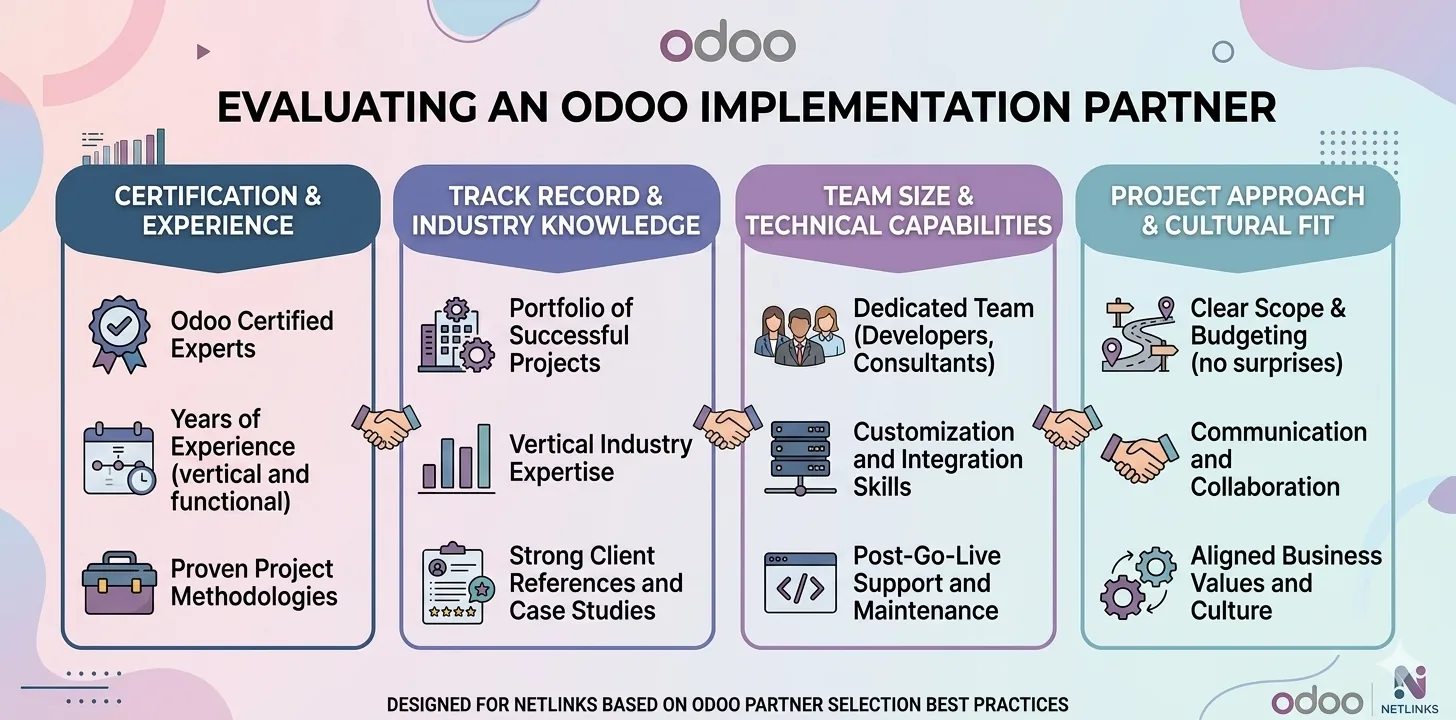
Why partner choice matters more than product choice
Odoo is a mature product with well-documented capabilities. Two different partners implementing the same scope on Odoo can produce radically different outcomes. One delivers on time, on budget, with a system that users adopt and finance trusts. The other ships late, blows budget via change orders, leaves unmaintainable custom code, and users end up reverting to Excel.
The difference isn't the product. It's the partner.
We've rescued dozens of failed Odoo implementations. In almost every case, the partner choice was the primary failure mode. Here's how to evaluate partners carefully before signing, so you don't become one of our rescue cases.
The green flags
1. Structured methodology they can explain in detail
Good partners have a documented methodology with specific phases, deliverables, and gate criteria. Ask them to walk you through it. Listen for specifics:
- What happens in discovery (workshops? data audit? current-state documentation?)
- How configuration is validated (weekly demos? structured UAT?)
- How migrations are rehearsed (one dry run? multiple?)
- How cutover is executed (runbook? go/no-go gates? rollback plan?)
- How hypercare works (duration? response SLAs? handoff plan?)
Partners who can explain this concretely are doing the work. Partners who say "we're agile and flexible" are hand-waving.
2. Senior-only team composition
Ask about team composition. Who will be on your engagement?
Green: Senior lead on every role. Named individuals with LinkedIn profiles you can verify. Multiple years of Odoo experience per person.
Red: "Our senior architect will oversee; the delivery team is onshore/offshore." This is code for "juniors will do the work and bill at senior rates." Quality suffers.
3. Honest timelines and pricing
Green: Discovery happens first. Firm proposal after discovery. Ranges with explicit assumptions. Willingness to walk away if the project isn't a fit.
Red: Fixed-bid before discovery. Aggressive sales pressure to sign quickly. Timelines that feel suspiciously short ("we can do it in 6 weeks!").
4. Open source ownership model
Green: You own all custom code. Source repositories belong to you. Documentation is delivered. Handoff to another partner is possible without renegotiation.
Red: "Our proprietary extensions" or "our framework" with license terms. Custom code stored in their repos. Documentation is sparse or tribal.
5. Transparent references
Green: Three reference clients you can call directly. Varied use cases. References willing to discuss what went well and what didn't.
Red: No references offered. References offered but you can't contact them directly ("we'll arrange a call"). References only willing to say positive things.
6. Realistic scope discussion
Green: They challenge your requirements. Push back on unclear scope. Recommend phased approaches where appropriate. Say "we don't recommend that" when something isn't right.
Red: Agree to everything. No pushback. Quote whatever you ask for without asking what you actually need.
7. Clear ongoing support model
Green: Transparent retainer pricing. Clear SLAs. Monthly or quarterly business reviews. No long-term contracts with exit penalties.
Red: "We'll talk about support after go-live." Long-term contracts with high exit costs. Vague SLAs.
The red flags
1. Fixed-bid without discovery
Any partner willing to fixed-bid an Odoo implementation before running structured discovery is making one of two mistakes:
- They're guessing (and will either over-quote and win you over on price, or under-quote and hit you with change orders)
- They're pattern-matching from previous implementations without understanding yours
Responsible partners fixed-bid only after discovery. If they'll commit to a number before discovery, be skeptical.
2. Offshore-heavy delivery without senior oversight
Offshore delivery can work, but only with strong senior oversight and clear communication protocols. When the entire delivery team is offshore with "monthly check-ins" from a senior architect, quality suffers substantially.
Ask: who will I talk to daily? weekly? for escalations? The answer should name specific individuals in your timezone or working hours.
3. Proprietary wrappers around Odoo
Partners who built "our framework on top of Odoo" or "our proprietary extensions" are creating lock-in. If you later want to change partners, you're stuck either paying the original partner's fees or doing an expensive re-implementation.
Ask explicitly: "What custom code will I own at the end? Can I take it to another partner?" The answer should be "you own all of it."
4. Aggressive sales cycles
Partners who want you to sign within a week, offer discounts that expire Friday, or pressure you on timeline before you've done proper evaluation are optimizing for closing the deal, not for your success.
Responsible partners give you time. They'd rather lose a deal to thoughtful evaluation than win a deal you'll regret.
5. Evasive references
Any partner unwilling to offer references you can talk to directly is hiding something. Insist on three references you can call yourself. Budget 30-45 minutes per reference call. Ask about:
- Timeline accuracy (on time? behind? how much?)
- Budget accuracy (on budget? over? by how much?)
- Quality of custom code
- Responsiveness during hypercare
- Ongoing support experience
- Would they hire this partner again?
6. Vague methodology descriptions
If asking about methodology produces vague answers ("we're agile," "we follow best practices"), dig deeper. If deeper questions don't produce specifics, the methodology probably doesn't exist in practice.
7. No answer for "what if it goes wrong?"
Partners who haven't thought about failure modes are partners who haven't run enough projects. Ask:
- "What's your rollback plan for cutover?"
- "What happens if reconciliation fails at go-live?"
- "What's your escalation path for P1 issues during hypercare?"
- "Can you share an example of a project that went badly and how you handled it?"
Responsible partners have thoughtful answers. Inexperienced or dishonest partners don't.
Interview questions worth asking
During partner evaluation, ask these:
- "Walk me through the last Odoo implementation you did at my scale."
- "Tell me about a project that didn't go well. What happened and what did you change?"
- "What's your typical ratio of senior to junior staff on an engagement?"
- "How do you handle scope changes? Walk me through your change-order protocol."
- "If we hire someone else after two years, what will it take them to pick up where you left off?"
- "What's your upgrade success rate across all your clients?"
- "Can I talk to three of your clients directly? Clients you pick, I pick, both."
- "What's your retention rate over 3+ years? 5+ years?"
Quality of answers matters as much as content. Partners who've done this work can answer specifically. Partners who haven't give hand-wavy answers.
Red-flag phrases
Listen for these during sales conversations, they're usually trouble:
- "We're like McKinsey but cheaper" (no, you're not)
- "We have a proprietary methodology" (translation: we don't have a methodology)
- "Our custom framework accelerates delivery" (translation: you'll never leave us)
- "Agile means we can iterate on scope" (translation: we don't have scope discipline)
- "Our offshore team is very experienced" (translation: we're billing senior rates for junior work)
- "We can start next week" (translation: we don't do proper discovery)
How we evaluate ourselves
A test: if a competitor's partner made you a better offer during evaluation, what would it look like? They might have lower rates, longer track record in your specific industry, closer geography, or stronger references. Those are legitimate reasons to pick them.
We've lost deals to competitors on all of those dimensions. We respect that. The partners we worry about are the ones who win deals on sales theater, fixed-bid commitments they can't meet, or obscuring their actual delivery model. Those are the partners creating bad outcomes that we eventually get called to rescue.
Conclusion
Evaluating Odoo partners carefully is the single highest-leverage thing you can do for implementation success. Spend the time. Talk to references. Ask hard questions. Pick the partner whose answers give you confidence that they know what they're doing and will tell you the truth when things get complicated.
If you'd like to talk to us as one of the partners you're evaluating, book a scoping call. We'll tell you honestly whether we think we're the right fit for your project, and if we're not, we'll try to suggest who is.
Related reading: Real cost of Odoo implementation · Odoo vs SAP Business One · Building upgrade-safe custom modules