Shopify + Odoo, building an integration that actually survives in production
How to integrate Shopify (storefront) and Odoo (ERP of record) for mid-market retailers. Architecture, failure modes, observability, and maintenance patterns.
Why most Shopify + Odoo integrations degrade
Shopify is an excellent front-end e-commerce platform. Odoo is an excellent back-office ERP. Together they form a solid unified-commerce stack for mid-market retailers. The integration between them is where most implementations quietly fail.
The typical failure mode: integration ships, works for 3-6 months, then starts dropping transactions silently. Shopify updates an API, the integration chokes on a new edge case, Odoo goes out of sync with inventory truth, customer-facing problems emerge, and the business spends weeks rebuilding confidence in the data. We've seen this dozens of times.
The root cause is nearly always the same: the integration was treated as a one-time project rather than a software product that requires ongoing maintenance.
The right mental model
Think of Shopify + Odoo integration as a software product with:
- An API contract between the two systems
- Explicit error handling and retry logic
- Observability into what's flowing where
- Versioning and release management
- Tests that run in CI
- An owner accountable for its health
When you design and maintain it this way, it runs reliably for years. When you treat it as a one-off project, it degrades within months.
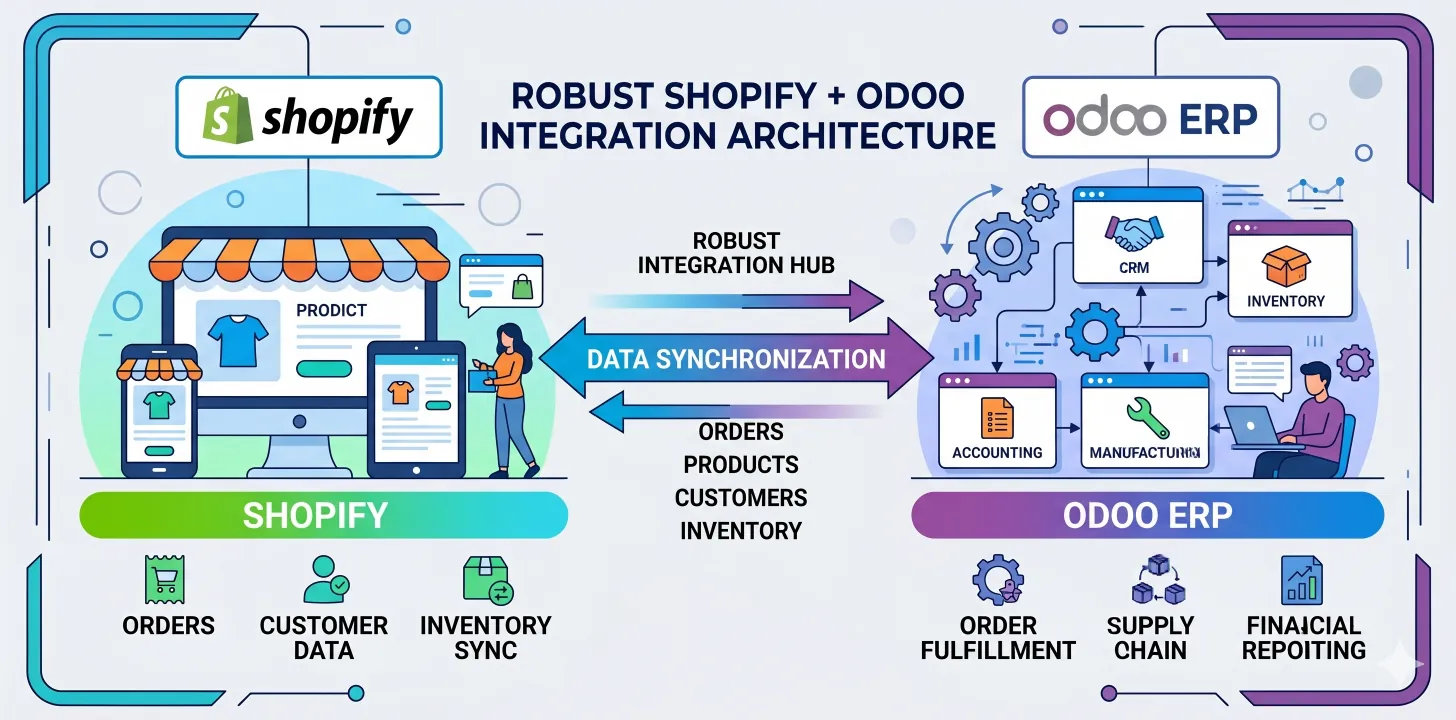
Core data flows
A robust Shopify + Odoo integration typically handles:
Product sync (Odoo → Shopify, near-real-time)
- Products created in Odoo push to Shopify within minutes
- Inventory quantity updates push continuously
- Price changes push continuously
- Product deactivations propagate
Order sync (Shopify → Odoo, real-time)
- Orders created on Shopify create Odoo sales orders within seconds
- Order updates (address changes, cancellations) propagate
- Fulfilment status syncs from Odoo back to Shopify
- Refunds initiated from either system propagate to the other
Customer sync (bidirectional, near-real-time)
- Customer records created in either system sync to the other
- Profile updates propagate (but carefully, avoid sync loops)
Inventory sync (Odoo → Shopify, near-real-time)
- Real-time stock updates as Odoo inventory changes
- Multi-location inventory where Shopify supports it
Fulfilment sync (Odoo → Shopify, real-time)
- Shipping confirmations with tracking
- Partial fulfilments
- Returns and restocking
Architecture patterns that work
Event-driven with webhooks
Shopify pushes events to Odoo via webhooks (orders, customers, refunds). Odoo pushes events to Shopify via GraphQL/REST API calls (inventory, products, fulfilments).
Queue-based for reliability
Webhook receivers write to a queue (Odoo's own job system or Redis). Workers process the queue with retry logic. If any step fails, the job retries with exponential backoff; persistent failures go to a dead-letter queue.
Idempotent operations
Every operation uses an idempotency key (Shopify order ID, customer email, SKU). Duplicate events process cleanly without double-posting.
Batched where appropriate
Real-time for orders and inventory; batched (hourly or daily) for analytics extracts, customer backfill, and reporting updates.
The observability you absolutely need
Any Shopify + Odoo integration running in production needs:
- Structured logs of every sync attempt (success/failure, entity type, duration)
- Alerting on dead-letter queue growth, if DLQ exceeds 10 items, page ops
- Dashboard showing throughput, error rate, and latency by data flow
- Daily reconciliation report, count of Shopify orders vs Odoo sales orders in past 24 hours
- Weekly integrity check, sample comparison of inventory, product, and customer records between systems
Without these, you'll know your integration is broken only when a customer complains. With them, you'll catch issues within hours.
Common failure modes
1. Shopify API version deprecation
Shopify deprecates API versions every 6 months. Integrations using deprecated versions eventually break. Mitigation: review API version quarterly, upgrade proactively.
2. Rate limiting
Shopify's rate limits (especially the bucket-based Leaky Bucket algorithm) catch unprepared integrations. Mitigation: implement proper backoff and bucket awareness.
3. Inventory oversells
Inventory deltas between Shopify and Odoo during sync lag cause oversells at peak times (Black Friday, seasonal launches). Mitigation: reserve inventory in Odoo before marking available in Shopify; aggressive rate of sync during high-traffic periods.
4. Currency and tax mismatches
Shopify and Odoo can compute tax differently, especially for multi-jurisdiction sellers. Mitigation: settle on a single source of truth for tax calculation (usually Avalara integrated with Odoo) and have Shopify defer.
5. Refund handling
Partial refunds, refunds against shipping, refunds that span multiple fulfillments, lots of edge cases. Mitigation: extensive test coverage of refund flows; explicit policy for what data flows where.
6. Customer data privacy
GDPR and CCPA compliance means customer data deletion requests must propagate. Mitigation: build customer-deletion webhooks on both sides; test the full flow.
Typical implementation cost
Basic integration (standard data flows, single warehouse)
- Timeline: 3-5 weeks
- Cost: $12-20K
- Covers: Product, inventory, order, customer, fulfilment sync with retry logic and basic observability
Advanced integration (multi-warehouse, complex product configurations, loyalty programs)
- Timeline: 5-8 weeks
- Cost: $20-40K
- Covers: All basic flows plus multi-location inventory, complex product variants, loyalty and gift card sync, advanced observability
Enterprise integration (multi-brand, multi-currency, international tax, custom workflows)
- Timeline: 8-14 weeks
- Cost: $40-100K
- Covers: Everything plus complex currency/tax handling, multi-entity routing, custom business logic
Ongoing maintenance
Budget $5-15K/year for maintenance:
- Quarterly Shopify API version upgrades
- Odoo version upgrade compatibility testing
- New feature additions as business needs evolve
- Observability tuning
- Emergency response for edge cases
If you're not budgeting for maintenance, you're setting yourself up for the degradation cycle we see so often.
When to rebuild vs. repair
We sometimes inherit poorly-built Shopify + Odoo integrations from previous partners. Our diagnostic:
Repair if:
- Core architecture is sound
- Under 3-5 documented issues
- Observability is reasonable
- You have 6-12 months of operational history
Rebuild if:
- No error handling or retry logic
- No observability
- Hard-coded credentials or inflexible deployment
- More than 10 documented issues
- Integration is less than 6 months old (no sunk cost)
Rebuilds typically take 3-6 weeks and cost $15-35K; they pay back in 6-12 months via reduced ops overhead and fewer customer-facing issues.
Conclusion
Shopify + Odoo integration done right is one of the highest-leverage investments a mid-market retailer can make, it eliminates the integration-maintenance tax that drags on operations and gives you real-time unified commerce visibility. Done wrong, it becomes a constant source of data issues and customer complaints.
The difference is treating it as software that needs maintenance, not a one-time integration project.
If you're planning a new Shopify + Odoo integration or troubleshooting an existing one, talk to us. We can audit what you have and estimate what it would take to get it to production-grade reliability.
Related reading: Retail & e-commerce industry page · Real cost of Odoo implementation