Odoo vs. SAP Business One, when each is actually the right call
An honest head-to-head between Odoo and SAP Business One for mid-market companies. Cost, flexibility, ecosystem, and the specific use cases where each is the stronger bet, from a certified Odoo partner who has migrated clients both onto and off Odoo.
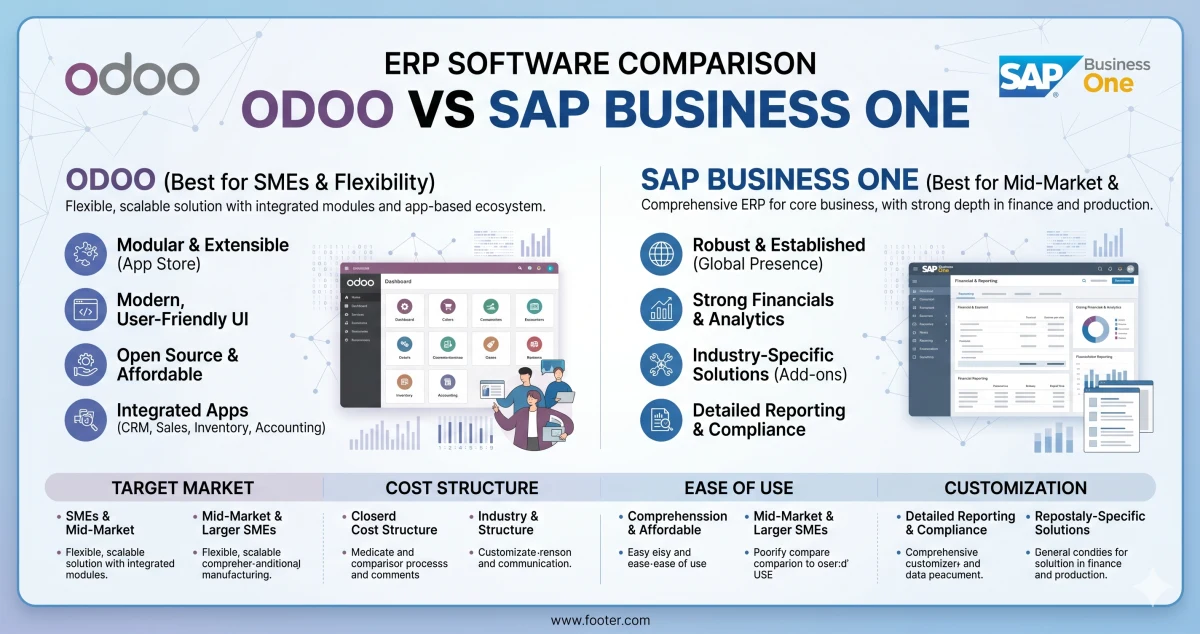
Introduction: why most vendor comparisons lie
Both Odoo and SAP Business One are legitimate choices for mid-market organizations. The vendor comparison you'll read online is almost always written by a partner of one product dismissing the other, or by a consultant quietly incentivized by a referral fee. This is our attempt at something less biased, written by a certified Odoo partner who has migrated clients both onto and off Odoo.
We'll cover where each product genuinely wins, what the real total cost of ownership looks like at mid-market scale, and the specific operational contexts where you should pick one over the other. No AI-generated feature-parity tables. No marketing-deck superlatives. Just the trade-offs we see in implementation work.
The honest version: both are legitimate mid-market ERPs
Both products work. Both have mature financial cores, multi-company operations, manufacturing workflows, and modern e-commerce integration. The question isn't "which is better", it's "which fits your specific business better."
We've seen Odoo implementations save companies hundreds of thousands per year versus SAP B1. We've also seen clients migrate from Odoo to SAP B1 because their specific edge cases (complex process manufacturing with deep warranty traceability, parent-company S/4HANA alignment) genuinely fit B1 better. The right answer is situational.
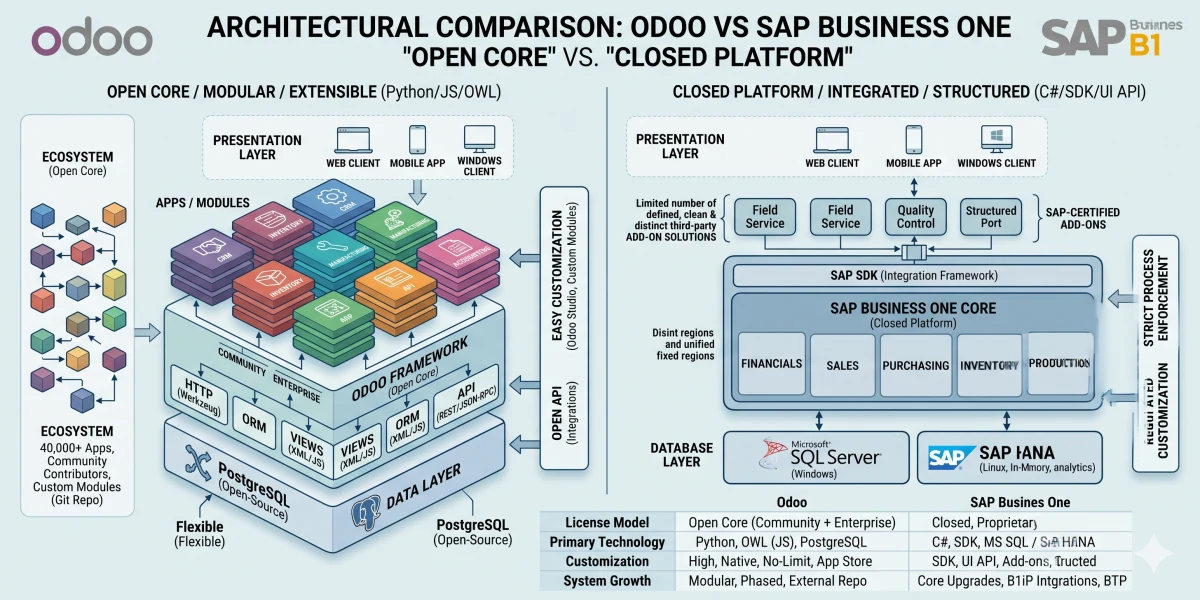
Where SAP Business One genuinely wins
Three contexts where SAP Business One is the stronger choice.
1. Complex discrete or regulated manufacturing
SAP B1's manufacturing handles specific edge cases out of the box that Odoo needs customization for:
- Multi-level configurable products with hundreds of variant combinations and configuration-dependent routings
- Deep serial-level warranty tracking across repair, replacement, and service events
- Regulated process manufacturing with strict compliance reporting (FDA 21 CFR Part 820 medical devices, pharma API under GMP)
Odoo can handle all of these with custom modules, but customization means engineering effort. If manufacturing is your core differentiator and you need these capabilities out of the box, take SAP B1 seriously.
2. You're already in the SAP ecosystem
If your parent company runs SAP S/4HANA and wants harmonized subsidiaries, B1 integrates cleanly via standard SAP connectors. You get:
- Consolidated reporting at group level
- Shared master data governance across entities
- Common user training and skills pool
- Single-vendor enterprise support relationship
Integrating Odoo into an SAP group is possible but adds middleware complexity, not always worth it when strategic alignment matters.
3. SAP brand credibility matters for stakeholders
Sometimes the answer is organizational. If you're raising institutional capital, going through IPO, or operating where auditors and bankers expect "SAP" on the tech slide, brand has non-technical value. Private-equity-backed companies are sometimes required by sponsors to run SAP regardless of fit. That's a legitimate constraint.
Where Odoo wins
For the remaining 80% of mid-market companies, our space, Odoo is the stronger choice.
1. Total cost of ownership is 40-60% lower
On equivalent functional scope at 50 users:
| Cost category | Odoo Enterprise | SAP Business One |
|---|---|---|
| Annual license (50 users) | $30K-50K | $55K-90K |
| Initial implementation | $50K-120K | $80K-180K |
| Annual support retainer | $36K-120K | $60K-180K |
| 3-year TCO estimate | $200K-500K | $350K-900K |
For mid-market companies where every six-figure category matters, this isn't rounding error. It's the difference between a dedicated systems administrator and stretching one person across too many tools.
2. Speed to value is 30-40% faster
- Odoo Enterprise (mid-market, 3-5 modules): 12-20 weeks from kickoff to production
- SAP Business One (equivalent scope): 16-28 weeks
Odoo's implementation ecosystem defaults to agile parallel workstreams; B1's partner ecosystem is older and defaults to waterfall. Odoo's configuration surface is also larger, more business logic you implement with settings rather than code.
3. Module breadth beats assembled ecosystems
Out of the box, Odoo covers CRM, sales, e-commerce, marketing automation, HR, payroll, recruitment, project management, subscriptions, point of sale, and field service as first-class modules. SAP B1 covers accounting, inventory, and purchasing, other modules come from a marketplace of add-ons with varying quality, each adding license cost and integration complexity.
For a mid-market company needing 6-8 modules, Odoo's consolidation is structurally more elegant.
4. Open architecture avoids vendor lock-in
Odoo's core is open source. Custom modules are standard Python you own outright. Data lives in PostgreSQL, you can query, back up, and export freely.
SAP B1's customization model (SDK, DI API, B1i) is more constrained. Database is HANA or SQL Server with vendor-specific licensing. Data ownership is technically yours but practically entangled with SAP's tooling.
For companies valuing long-term flexibility and the option to walk away from a partner, Odoo's architecture is materially better.
Real-world comparison: a mid-market distributor
A regional distributor with:
- 120 employees across 3 warehouses and corporate office
- $45M annual revenue, 8,000 active SKUs, 400 B2B customers
- Outgrowing QuickBooks Online + spreadsheets + Shopify for e-commerce
Three-year TCO: Odoo path $446K vs SAP B1 path $695K.
Functional coverage: Both cover the core (accounting, inventory, purchasing). Odoo adds e-commerce, CRM, subscriptions, POS, marketing automation as native. SAP B1 requires marketplace add-ons for equivalent coverage.
For this client, Odoo is clearly the stronger choice. The only reason to pick SAP B1 would be if their parent company ran S/4HANA (it doesn't) or they needed FDA-regulated manufacturing (they don't, they're a distributor).
How to pick
Pick SAP Business One if:
- You're a manufacturing subsidiary of an S/4HANA parent
- Your manufacturing is complex, regulated, and a core differentiator
- Your board or investors require SAP branding on the tech stack
- You have deep SAP skills in-house
Pick Odoo if:
- You're outgrowing QuickBooks, Xero, or legacy custom systems
- You need 5+ modules and don't want to assemble a marketplace of add-ons
- Cost sensitivity is real (it usually is at mid-market scale)
- You value architectural flexibility
For anything borderline, talk to partners of both and judge whose questions are better. The partner who asks harder questions delivers better outcomes regardless of product.
Common objections
"SAP is safer." Only if "safer" means "more expensive and slower to deliver." ERP failure rate is similar across both; what distinguishes successful implementations is partner quality and organizational readiness, not vendor brand.
"Odoo is open source, isn't it risky?" Odoo SA is a well-capitalized public company (EBR:ODOO) with 12M+ users, SOC 2 Type II certification, and an enterprise product with SLAs. The "open source is risky" concern applied to early-stage projects; it doesn't apply to Odoo in 2026.
"Custom Odoo won't survive upgrades." True for badly written code. Correctly written custom modules, following Odoo inheritance conventions, tested against new releases, survive upgrades fine. Our upgrade success rate across client estates is 98%+.
Conclusion
The best way to pick between Odoo and SAP Business One is to forget both products exist for the first two weeks of evaluation. Write down business requirements, constraints, and deal-breakers in plain language. Then map those to products, the answer is usually obvious once requirements are clear.
If you want a second opinion on a specific evaluation, talk to us. We'll tell you honestly whether we think Odoo is right for your situation, and if SAP B1 is the better fit we'll say so, we'd rather lose the deal than deliver the wrong solution.
Related reading: Odoo vs NetSuite comparison · The real cost of an Odoo implementation · How to evaluate an Odoo implementation partner